
Why Leyton Orient Are Called
The O’s.
A shipping company, a letter on the back of a shirt, and a club that has changed its name so many times that the nickname became the only constant.
Leyton Orient have been called the O’s for so long, and so consistently, that it is easy to forget the nickname is just one letter taken from the club’s actual name. The O’s are Orient. Orient is the O. It is, on the surface, the most straightforward nickname in this series — a single letter, a single sound, an abbreviation so obvious it barely counts as a nickname at all.
And yet the story of how a football club in east London came to be called Orient in the first place is considerably stranger than the nickname it eventually produced.
The club was founded in 1881, not as a football club, but as is often the case with early clubs, as the Glyn Cricket Club, an offshoot of cricketers from Homerton College in Hackney looking for a winter activity.
They became Eagle Cricket Club in 1886, then Orient Football Club in 1888.
That last change, the one that matters for our purposes, came at the suggestion of a player named Jack Dearing, who at the time worked for the Orient Shipping Company.
He thought it had a good ring to it. He was right, as it turned out, though the name would spend the next sixty years being moved around east London like a piece of furniture nobody could quite agree where to put.

The Letter on the Back
Between 1899 and 1905, Clapton Orient — as they were then known — wore blue shirts with a large white O on the back. It was a simple design choice rather than a deliberate piece of branding, a way of identifying the players on the pitch at a time when shirt numbers were still decades away. But the crowd latched onto it. “Play up the O’s” became the natural terrace shout, and the nickname followed the letter rather than the other way round.
It is one of the more accidental nickname origins in this series — not a mishearing, not a fishmonger, not an ancient siege, just a letter that supporters found natural to shout at. By the time the shirts changed, the O’s had already stuck. The nickname outlasted the kit that created it by over a century, which says something about how quickly these things take root once a crowd starts using them.
The nickname O’s came about when in their early days Orient wore shirts with a big white O on the back and the supporters would shout “play up the O’s.”
The Beautiful History, on the origins of the nickname
A Club That Could Not Stop Changing Its Name
While the O’s nickname remained fixed, everything else about the club’s identity was in near-constant flux. Orient Football Club became Clapton Orient in 1898, a bid to attract the support of the more affluent residents of Clapton. They were elected to the Football League in 1905. In 1937 the club moved to the ground they still occupy in Leyton, and in 1946 — after narrowly avoiding bankruptcy — they changed their name to Leyton Orient Football Club.
Then, remarkably, in 1966 they dropped the Leyton altogether and became simply Orient. It was the kind of rebranding decision that suggests someone in the boardroom had been reading too many marketing books — the thinking being that a shorter, more mysterious name would have broader appeal. It did not notably broaden anything, and in the early 1980s Leyton was reinstated. The club has been Leyton Orient ever since, though supporters have called them the O’s throughout every single one of these permutations without breaking stride.
The Shipping Company, the Wyverns, and the Eastern Mystery
The Orient Shipping Company, whose employee Jack Dearing lent the club its name in 1888, was one of the major Victorian shipping lines operating routes to the Far East and Australia — later absorbed into what became P&O. The eastern connotations of the name were not accidental, and they found their way eventually onto the club’s badge in a form that has perhaps confused supporters ever since.
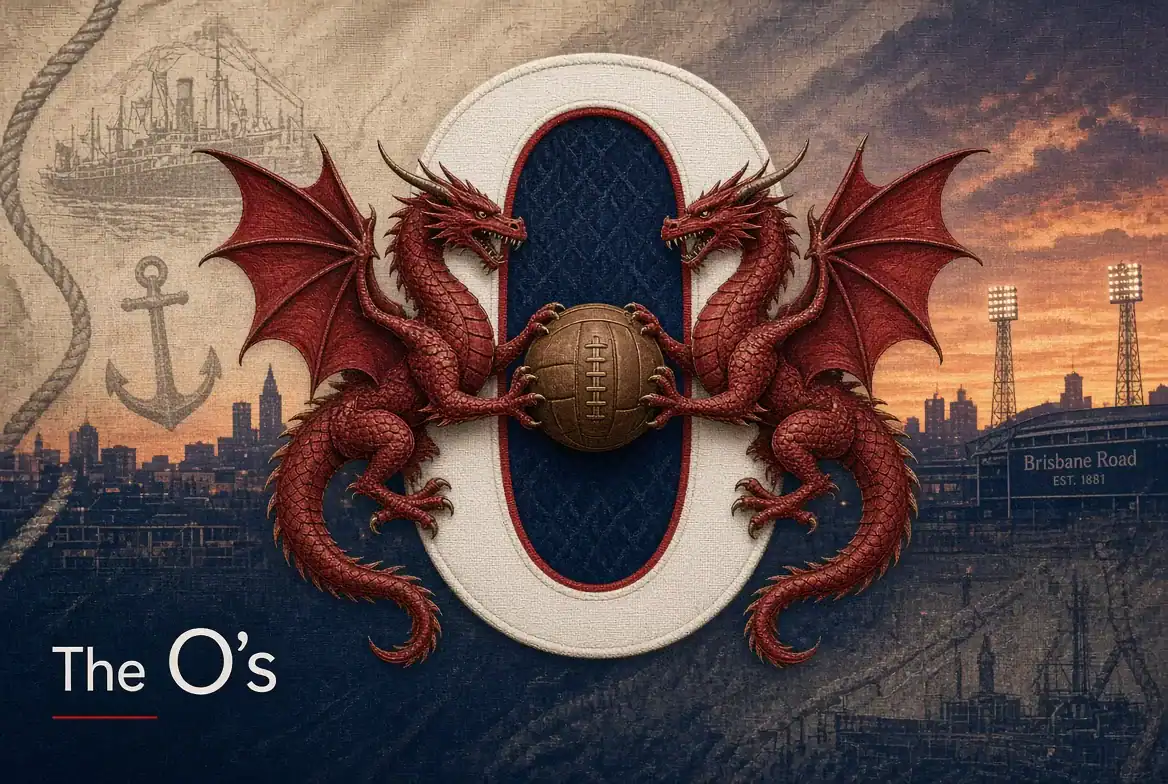
The creatures on the Leyton Orient crest are not, as is widely assumed, dragons. They are wyverns, mythological creatures that are half-dragon, half-serpent, traditionally associated with the Thames and with the defence of waterways.
The wyvern is the heraldic symbol of the City of London’s connection to the river, and its appearance on Orient’s badge links the club to both the shipping heritage that gave them their name and the specific geography of east London through which the Thames flows.
The badge, in other words, was designed around an error, the assumption that dragons and wyverns were the same thing, but the error produced something that was actually more historically appropriate than the intended design would have been. Which is a more fitting origin for a Leyton Orient badge than anyone planned.
Leyton Orient were founded in 1881 as Glyn Cricket Club, making them the second oldest professional football club in London.
The name Orient came from a suggestion by player Jack Dearing, who worked for the Orient Shipping Company, in 1888.
The O’s nickname derives from the large white O worn on the back of blue shirts between 1899 and 1905.
The club has traded under at least five different names: Glyn Cricket Club, Eagle Cricket Club, Orient FC, Clapton Orient, Orient, and Leyton Orient.
The creatures on the club’s badge are wyverns, mythological half-dragon, half-serpent figures, not dragons, as is widely believed.
The Nickname That Held Everything Together
What the O’s story illustrates, more clearly than almost any other club in this series, is the function a nickname actually serves. Leyton Orient have changed their name repeatedly, moved grounds several times, bounced between divisions, flirted with bankruptcy, briefly dropped part of their own name in a fit of rebranding enthusiasm, and at various points been associated with a shipping company, a Victorian college cricket club, and a letter of the alphabet. Through all of it, the O’s remained constant.
Nicknames are more durable than official names, more resistant to ownership changes and marketing decisions and administrative reorganisations. The O’s was never chosen, it emerged from a crowd who found it natural to shout. That is exactly why it survived everything the club’s official identity went through. When the rest is uncertain, the nickname holds.
Previously: Why Sheffield Wednesday are called the Owls — and why the owl was never really a bird.
Next: Coming soon.

John Herman is a Leeds-based, would-be football writer and founder of Football Nonsense. Blending fan passion with sharp opinion, attempting to tackle the game’s biggest debates, from the terraces to the boardroom, with honesty, (attempted) humour, and heart.