
Why West Brom Are Called
The Baggies.
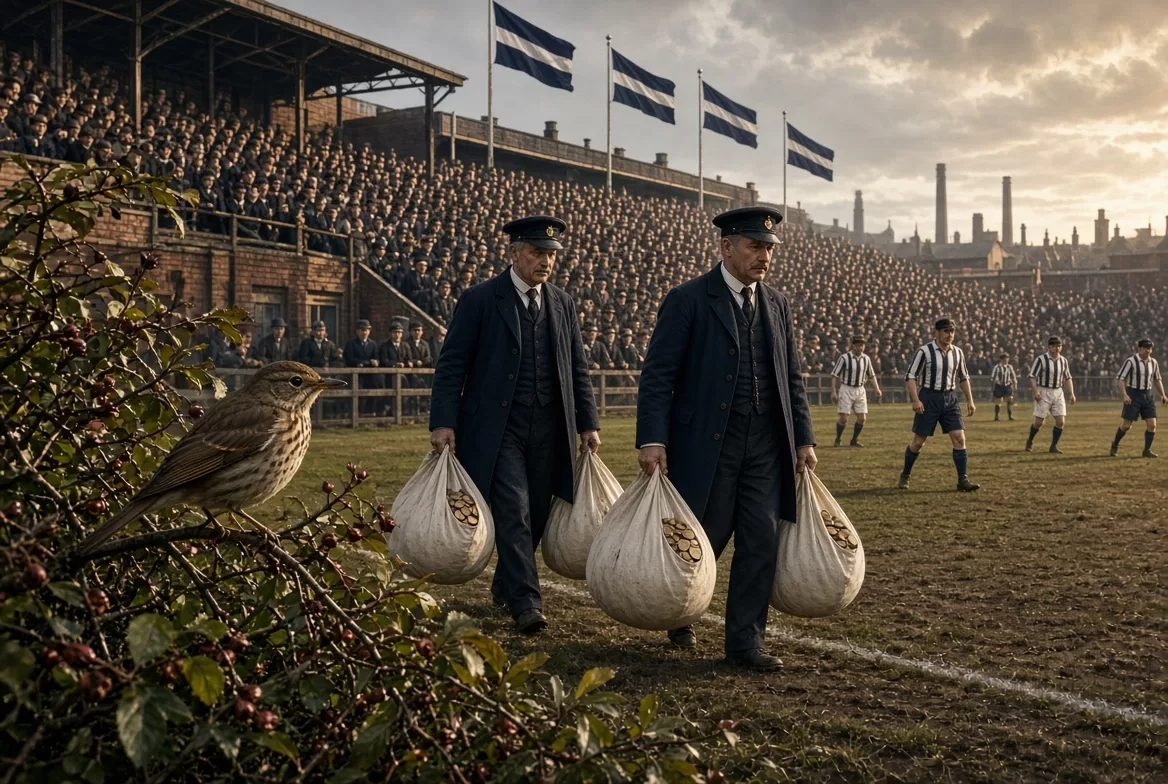
A thrush on the crossbar, money bags along the touchline, and an insult from Aston Villa supporters that got turned around. West Brom’s two nicknames are both genuinely old, both genuinely interesting, and both very Black Country.
West Bromwich Albion are unusual in the Nickname Files series for having two nicknames that are genuinely used, genuinely old, and genuinely interesting.
The Throstles is the older one — rooted in the Black Country landscape and a bird that apparently liked sitting on goalposts, and the Baggies is the more widely used one today, with origins that remain disputed a century after the name first appeared.
Most clubs would be happy with one good nickname story. West Brom, has managed two.
The club started in 1878 as West Bromwich Strollers, formed by workers from Salter’s Spring Works in West Bromwich — a group of men who walked to Wednesbury to buy the club’s first ball, which tells you something about both their commitment and the era they were playing in.
They renamed themselves West Bromwich Albion in 1880, becoming the first club to adopt the Albion suffix, and spent their first two decades moving between grounds before settling permanently at the Hawthorns in 1900.
It was that move, and the landscape around the new ground, that produced the first and older of their two nicknames.
The Throstles: A Bird on the Crossbar
Long before West Bromwich Albion was associated with the name “The Throstles”, the inhabitants of West Bromwich were traditionally known as “throstles” dating back to the 1750s.
A throstle, the old English term for a thrush, is a songbird that was apparently common throughout the area, and the association between West Bromwich and the bird predated the football club by well over a century.
The new ground brought the nickname with it almost automatically. The Hawthorns sat in an area of hawthorn bushes, hence the name, which were exactly the kind of habitat where thrushes thrive.
The connection was almost too neat: a ground named after hawthorn bushes, in an area already associated with thrushes, adopted by a club the local community already called Throstles. No committee was needed. The nickname simply landed.
The inhabitants of West Bromwich had long been known as throstles — the local Black Country word for a songbird common throughout the area — and when the football club arrived, it inherited the name as naturally as it inherited the landscape.
Black Country football history, on the origins of the Throstles nickname
What followed was one of the more eccentric mascot arrangements in English football history.
At one time, a live thrush was kept at West Bromwich Albion in a cage which was hung out over the players’ tunnel on match days. A live bird, suspended above the tunnel, watching the players emerge. Whether the players found this inspiring or unsettling is not recorded, though the bird itself apparently took the arrangement in its stride.
The live thrush is long gone, but there is still a giant model that used to sit on the scoreboard, and the throstle remains on the badge, on the club crest, and in the DNA of a club that has never quite shaken its Black Country roots regardless of how many times it has yo-yoed between the Premier League and the Championship.
The Baggies: Three Theories and an Insult
The Baggies nickname is more recent — first being heard in the very early 1900s, and its origins are considerably more disputed. There are at least three competing explanations, none of them conclusively proven, all of them plausible.
The most unremarkable theory involves, as you might expect, shorts. Victorian and Edwardian footballers wore considerably more generous shorts than their modern counterparts, and West Brom’s were apparently notable even by the standards of the era. It is not the most thrilling origin story, but it has the virtue of simplicity.
A more vivid explanation involves money.
In its early days, The Hawthorns had only two entrances, one behind each goal. On match days the gatekeepers would gather up the takings at each end and be escorted by policemen along the sides of the pitch to the centre line.
The sight of gatekeepers marching along the touchline with bags of money, escorted by a police guard, became a familiar part of the matchday ritual at The Hawthorns — and the Baggies, according to this story, were named after those money bags rather than any item of clothing.
The third theory involves Aston Villa, adding an extra dimension of local satisfaction.
Albion supporters adopted what had initially been intended as a derogatory insult by fans of their Midlands rivals, referring to the clothing worn by factory workers.
Local ironworkers attending matches in their protective work trousers — large, heavy, unmistakably industrial garments — became the target of mockery from Villa supporters, who used the Baggies tag as a put-down. West Brom fans simply turned it around, as football communities have always done with insults that carry a certain ring.
West Bromwich Albion were founded in 1878 as West Bromwich Strollers, making them one of the oldest clubs in the Football League.
They were the first club in England to adopt the “Albion” suffix, doing so in 1880.
The Hawthorns, which opened in 1900, is the highest Football League ground above sea level in England, at around 551 feet.
The Baggies nickname appears in documented form from the early 1900s — three competing theories about its origin remain unresolved to this day.
West Brom have been promoted and relegated between the Premier League and Championship eight times since 2002 — a yo-yo record unmatched in the modern era.
Two Nicknames, One Identity
What makes the West Brom story distinctive in this series is that both nicknames are still genuinely in use. The Baggies is the one you hear most often — on commentary, in headlines, from supporters — but the Throstles has never disappeared.
It lives on in the badge, in the club’s official history, in the name of the club’s documentary series, and in the affectionate usage of older supporters for whom the bird has always meant more than the money bags.
There is something fitting about a Black Country club carrying two nicknames rather than one.
The Black Country itself perhaps resists easy definition — it is not quite Birmingham, not quite the wider Midlands, a specific industrial landscape with its own dialect, its own pride, and its own sense of being perpetually misunderstood by everyone outside it.
A club with two nicknames, both rooted in the specific textures of that place, feels exactly right.
The thrush sat on the crossbar. The money bags went along the touchline. The ironworkers arrived in their baggy protective trousers, absorbed the insults, and turned them into something worth singing about. West Brom have been doing that, one way or another, for nearly 150 years.
Previously: Why Lincoln City are called the Imps — a medieval legend, a mischievous creature turned to stone, and a football club that once shared its pitch with cows.
Next: Why Birmingham City are called the Blues — and why the name tells only half the story.

John Herman is a Leeds-based, would-be football writer and founder of Football Nonsense. Blending fan passion with sharp opinion, attempting to tackle the game’s biggest debates, from the terraces to the boardroom, with honesty, (attempted) humour, and heart.