

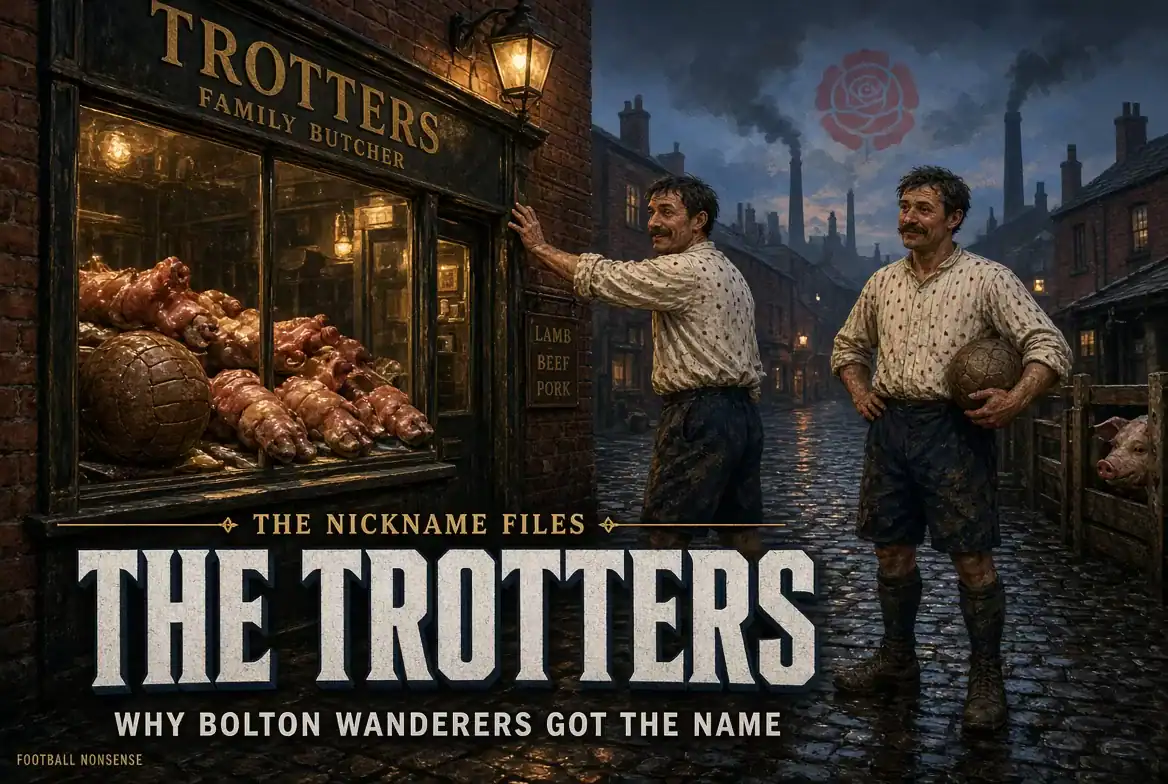
Why Bolton Wanderers Are Called
The Trotters.
A vicar, a pig pen, a butcher’s shop window full of sheep’s feet, and a town with a reputation for fleecing visitors. Four theories, one nickname, and nobody entirely sure which story is true.
Bolton Wanderers have perhaps one of the more chaotic origin stories in English football, and that is before you even get to the nickname.
The club was founded by a Sunday School teacher in 1874, promptly fell out with the local vicar, changed its name in a fit of pique, spent years unable to find a permanent ground to play on, and only settled its identity through a combination of stubbornness and circumstance.
The Trotters’ nickname that eventually attached itself to the club has at least four competing explanations, none of them particularly proven to be true, but all of them plausible in their own way.
Bolton, it seems, has always done things the complicated way. Something I’m sure many fans can identify with.
The club began as Christ Church FC, founded by Reverend Thomas Ogden, a schoolmaster who ran the team from his church on Deane Road in Bolton.
When the local vicar, apparently a man with strong opinions about how church premises should be used, refused to allow meetings at the church in his absence, so the club simply left.
In 1877 they renamed themselves as Bolton Wanderers, the Wanderers element chosen specifically because the club had already played at three different venues in four years and had not yet found anywhere to settle.
The name was less a statement of identity, perhaps more just an honest admission of their lack of a permanent home.

So let’s take a look at the various interesting theories on how Bolton Wanderers came to get their nickname.
Theory One: The Practical Jokers
The oldest and arguably most interesting explanation for the Trotters nickname has nothing to do with football, pigs, or food.
In old Lancashire dialect, a trotter was a practical joker, someone who would play tricks on visitors to the town, fleecing them out of money or leading them astray for local amusement.
The practice was apparently common enough in Bolton that outsiders coming to the town were warned to watch themselves, as the residents had acquired a reputation for it.
On this line of thinking, the Trotters’ nickname is more or less an inherited insult, the kind of thing rival towns called Bolton people, which Bolton people eventually adopted with enough pride that it stuck to their football club.
It’s perhaps similar to the way that Millwall’s supporters embrace the Nobody Likes Us chant, or the way plenty of working-class communities have reclaimed the names that were originally aimed at them, eg. Smoggies at Middlesbrough.
Arguably there is a certain defiant charm to a football club whose nickname derives from a regional reputation, in this case, for separating visitors from their money.
Theory Two: The Pig Pen
A second theory is more literally grounded – in a piggery, specifically.
One of Bolton’s earliest grounds, before the club settled at Pikes Lane, was apparently next to a pig farm. So when the ball went over the fence, as balls do, players were required to retrieve it by making their way through the pig pens.
The act of picking through a pig farm to collect a lost football, it is suggested, led to the players being called Trotters, after the simple fact that they were required to navigate a pen full of pigs without disturbing them, to get the ball back .
This theory probably has a quality of detail that gives it a ring of truth, even if it has the slightly too-neat quality of a story that was invented after the fact to explain something nobody could quite remember. It is the kind of origin story that football loves — specific, absurd, and completely impossible to verify.
Theory Three: The Butcher’s Window
The third and most widely repeated explanation involves food. Trotters — boiled pigs’ or sheep’s feet — were a popular local delicacy in Victorian Bolton (it was always pigs’ trotters that were/are eaten to my mind, but it does seem that trotters can be sheep’s feet too), the kind of dish that working-class communities across Lancashire ate regularly and that outsiders found notable enough to comment on.
The story goes that on the occasion of a particularly important early match, a large supply of trotters was laid on for visiting supporters, with piles of sheep’s feet displayed prominently in a butcher’s shop window near the ground.
Boiled sheep’s feet, commonly known as trotters, are supposed to be a favourite dish with the people of Bolton. The story goes that, on the occasion of one famous match, a large supply was provided for the visitors. Piles of sheep’s feet were displayed in the shop window, and they created such an impression that Wanderers were at once dubbed the Trotters.
Historical account of the Bolton Wanderers nickname origin
The visual impression of a shop window full of trotters apparently lodged itself in the visiting supporters’ memory, and the association — Bolton, trotters, the match — transferred itself to the club.
It is a more ordinary origin story than the practical joker theory, but it has the virtue of being the kind of thing that genuinely happened in Victorian football culture, where local food traditions and match days were closely intertwined.
Theory Four: Wanderers in Disguise
The fourth theory is the simplest and maybe the least satisfying: Trotters is merely a variation on Wanderers, an informal description for people who roam around without settling in one place.
On this reading, the nickname was never more than a synonym for what the club already called itself, a piece of playground wordplay that stuck.
It requires no butcher’s shop, no pig pen, no local tradition of fleecing tourists — just someone with a modest talent for paraphrase and a crowd who found it easier to chant.
So, the honest answer is that probably nobody knows which of these four theories is correct, and there is a reasonable possibility that any or all of them contributed in some way.
Of course, nicknames do not always have a single, clean origin. They accumulate meaning from multiple directions, get reinforced by coincidence, and eventually achieve a kind of cultural weight that makes the question of their precise origin almost irrelevant.
The Trotters is what Bolton Wanderers are. The pigs’ feet, the practical jokers, the wandering players, and the butcher’s window are all part of the same story now, whether or not any one of them started it.
Bolton Wanderers were founded in 1874 as Christ Church FC by Sunday School teacher Reverend Thomas Ogden, and renamed in 1877 after a dispute with the local vicar.
They were one of the twelve founder members of the Football League in 1888 — six of the twelve came from Lancashire.
Bolton won the FA Cup four times: 1923, 1926, 1929, and 1958, making them one of the most successful FA Cup clubs of the twentieth century.
The 1923 FA Cup final — the first at Wembley — saw a white police horse famously used to clear the pitch of supporters before the match. Bolton won 2–0.
Bolton spent eleven consecutive seasons in the Premier League between 2001 and 2012, reaching a League Cup final and two UEFA Cup campaigns during that period.
A Nickname Worth Having Either Way
What is certain is that the Trotters suits Bolton Wanderers in ways that none of the competing theories can fully account for.
There is something in the word, slightly comical, vaguely self-deprecating, with hints of northern practicality and a refusal to take itself too seriously; that fits a club whose history runs from Sunday School rebellion through Victorian FA Cup glory to Premier League football and back down through the divisions again.
The Trotters is not a grand nickname. It does not suggest power, speed, or nobility. It suggests a club that has been around long enough to acquire a few stories, not all of them flattering, and has decided to wear them without embarrassment.
For a club that started life falling out with a vicar and named itself after its inability to find a home, that feels entirely appropriate.
Previously: Why Leyton Orient are called the O’s — a shipping company, a letter on a shirt, and a club that could not stop changing its name.
Next: Why Birmingham City are called The Blues and why it’s not as obvious as you’d think.

John Herman is a Leeds-based, would-be football writer and founder of Football Nonsense. Blending fan passion with sharp opinion, attempting to tackle the game’s biggest debates, from the terraces to the boardroom, with honesty, (attempted) humour, and heart.