

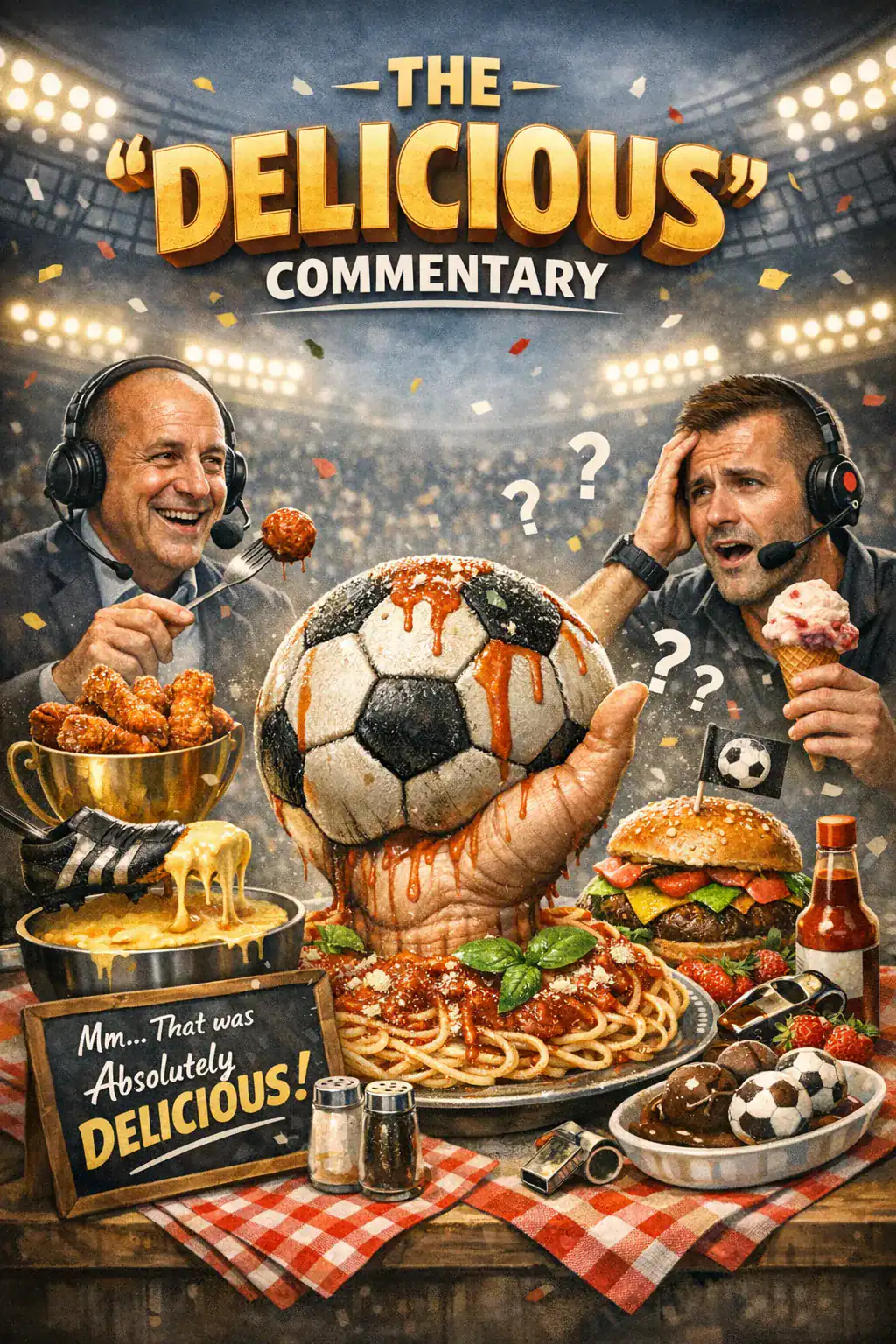
Does the Word “Delicious” Belong in Football Commentary?
Culinary vocabulary has crept into the commentary box. But when commentators reach for food metaphors, are they serving football, or undermining it?
There it is again. A midfielder plays a neat triangle pass, and the commentator purrs: “Oh, that’s delicious.” A winger skips past a full-back, and the studio pundit leans forward: “Just delicious football.” An attacking move flows through five players and ends with the ball nestled in the corner of the net, and the man behind the microphone reaches for the same word he uses to describe, apparently, everything that pleases him.
Since when did football become something you eat?
Now, before you reach for the comments section to tell me it’s just a word, it isn’t just a word, though, is it? Language matters. The vocabulary we use to describe football shapes how we think about it, how we feel about it, and ultimately what we believe it to be. And “delicious,” with all its culinary warmth and passive, pleasurable connotations, is quietly doing something rather odd to the way we talk about the game.
Of course, Football Has Always Had Its Own Language
The traditional vocabulary of football commentary was rooted in competition. A great pass was brilliant. A striker’s finish was clinical. A tackle was crunching. A team was resilient, a manager tactically astute. Even the compliments were functional; they told you something about what the action did, about its purpose and effect within the context of a contest.
Think back to the great commentators — Barry Davies, John Motson, Brian Moore. Their vocabulary emphasised what mattered in the moment. “And Smith must score!” captures urgency, opportunity, and consequence. “Nothing less than magnificent!” said of Maradona’s second goal against England, tells you something was exceptional, historically so, within the frame of competitive sport.
“A delicious pass isn’t incisive. It isn’t decisive. It isn’t anything in particular, except pleasant to observe. The word tells you nothing about function, purpose, or competitive effect. It’s a word that belongs in a restaurant review, not on a football pitch.”
The Aestheticisation of Football
The rise of aesthetic vocabulary in commentary is not accidental. Over the last two decades, football, particularly the Premier League, has been packaged and sold as entertainment. The matchday experience, the studio production, the camera angles, the music, the graphics, all of it is designed to make watching football feel like watching premium television. And premium television gets described in the language of pleasure, taste, and sensation.
“Delicious” fits perfectly into that world. It’s the kind of word that says: this is something to be savoured, to be enjoyed, to be consumed. It positions the viewer as an audience member rather than a supporter, as someone experiencing entertainment rather than someone invested in a contest.
And there’s the problem. Because football is not primarily entertainment. It is, after all, a competition. It has stakes. It has consequences. Someone wins, and someone loses, and that matters to the players, the managers, and especially to the fans who’ve shelled out sixty quid for a ticket or got up at six in the morning to watch from the other side of the world.
When you describe a pass as “delicious,” you’re prioritising its aesthetic quality over its competitive significance. The pass might also have been crucial, decisive, or perfectly weighted to unlock the defence. But none of those descriptions made it to air. Instead, we got a word that tells us it was nice to look at.
The Inconsistency Problem
Here’s what makes the stylisation of commentary particularly irritating: it’s wildly selective.
Not all football is beautiful. Most football, frankly, isn’t. Football is scrambled clearances and misplaced passes and fourth officials holding up a board for six minutes of added time while a striker rolls around holding a shin that wasn’t touched. Football is freezing cold terraces, dropped points, and late equalisers for teams that park eleven men behind the ball for ninety minutes.
Commentators, quite reasonably, don’t describe any of that as delicious. But they also don’t describe it as the essential, honest reality of football that it is. Instead, the aesthetic vocabulary, “delicious,” “gorgeous,” “sumptuous, is reserved exclusively for the pretty passages, creating a kind of highlight-reel commentary that only celebrates one dimension of the game.
“What about the defender who wins every header, organises his back four under relentless pressure, and makes the decisive interception with two minutes to go? He doesn’t get called delicious. And yet his contribution might matter more than any of the silky passing.”
The selective use of aesthetic language reinforces a hierarchy of value that doesn’t really reflect the game. Skill and beauty are celebrated with lavish vocabulary; graft and organisation are noted, if at all, in the flattest of tones.
It’s Not About Being a Killjoy
This might seem like a sort of winging rant, but none of this is an argument against appreciating beauty in football. Football can be beautiful. The perfectly weighted through ball, the first touch that controls a ball dropping from thirty yards, the movement of a team in full attacking flow, these things are genuinely special and worth celebrating with genuine enthusiasm.
But there’s a difference between celebrating them with precision and celebrating them with vagueness. “Delicious” is vague. It tells you that something pleased the commentator without telling you why, how, or what it means. It’s the verbal equivalent of a thumbs-up emoji, emotionally sufficient, intellectually empty.
Better commentators find better words. They tell you the pass was weighted to exploit the space left by the full-back stepping up. They tell you the first touch was exceptional because the ball was travelling at pace from an awkward angle. They tell you the movement was devastating because it created a two-versus-one that the defence simply couldn’t recover from. That’s commentary that adds something, that deepens your understanding of what you’re watching.
“Delicious” adds nothing. It just sits there, smelling faintly of a Michelin-starred kitchen, while the football carries on without it.

What’s Next — “Scrumptious”?
If “delicious” has become acceptable, presumably “scrumptious” is on its way. Perhaps “moreish.” Maybe an especially good counter-attack will be described as “a proper three-course meal of a move, with a delightful amuse-bouche in the build-up play.”
The slippage of vocabulary is worth resisting, not because words are sacred, but because precision in language reflects precision in thought. Commentators who reach for vague, borrowed vocabulary aren’t thinking clearly about what they’re watching. And commentary that doesn’t think clearly about what it’s watching isn’t commentary worth listening to.
The next time a commentator calls a pass delicious, ask yourself: What does that actually mean? Is it precise? Is it useful? Does it tell you anything about the football?
Or does it just tell you the commentator had a very nice lunch?
What do you think? Does football commentary vocabulary matter, or is it all just background noise? Drop your thoughts in the comments below — we’d love to hear from you.

John Herman is a Leeds-based, would-be football writer and founder of Football Nonsense. Blending fan passion with sharp opinion, attempting to tackle the game’s biggest debates, from the terraces to the boardroom, with honesty, (attempted) humour, and heart.