

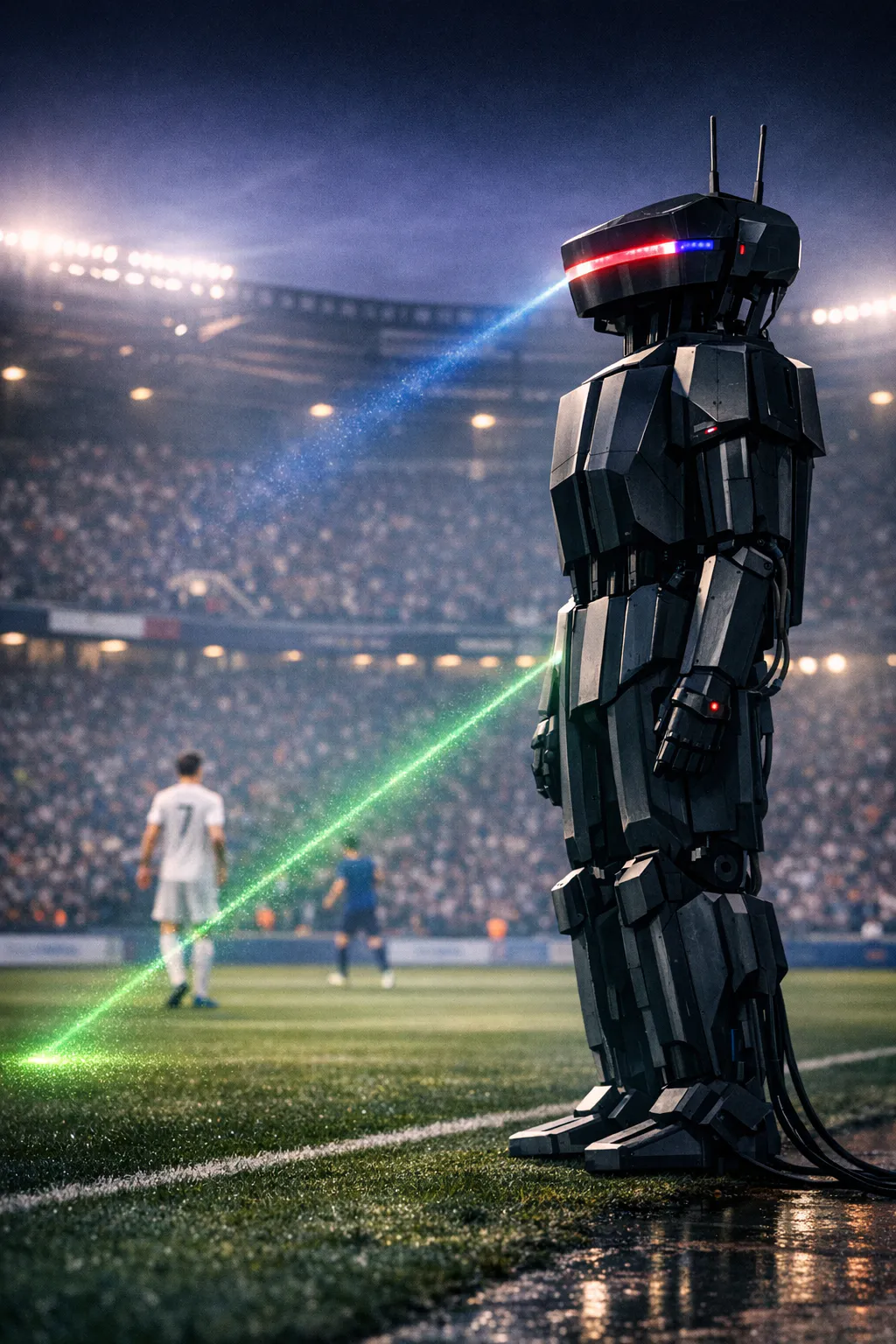
The Chinese Football Association has announced the successful development and domestic deployment of the world’s first fully autonomous robot referee system.
Officials say it eliminates human error entirely. Early match data suggests it may have introduced several new categories of error previously unknown to the sport.
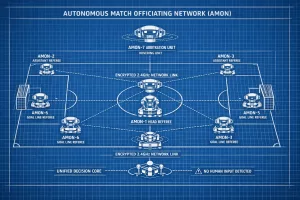
China, it appears, has had enough of human beings. Announced quietly last month by the Chinese Football Association (CFA) in a 340-page technical document that has so far been read in full by approximately three people, the Autonomous Match Officiating Network — or AMON — represents what its designers describe as “the complete and permanent removal of subjective judgement from association football.”
Each match is overseen by a team of seven referee units, designated AMON-1 through AMON-7, which patrol the pitch on wheeled platforms, enforce all 17 Laws of the Game in real time, and communicate with one another via encrypted radio signal at 2.4 gigahertz.They do not consult with players. They do not explain their decisions. And, crucially, they cannot be shown a yellow card.
How the AMON Robot Referee System Works
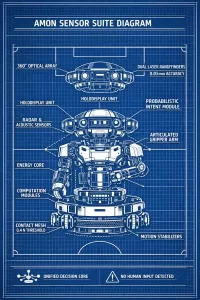
Each AMON unit is equipped with a suite of sensors, including 360-degree optical tracking cameras, ground-penetrating radar for pitch-surface monitoring, dual laser rangefinders accurate to 0.03 millimetres, a contact-detection mesh capable of registering forces as low as 0.4 newtons, and what the technical document describes as a “probabilistic intent-assessment module” — a phrase that will require further examination shortly.
The units operate under a unified decision-making architecture. AMON-1 acts as the primary match official. AMON-2 and AMON-3 function as assistant referees and operate along the touchlines. AMON-4 serves as the fourth official. AMON-5 and AMON-6 handle goal-line and penalty-area monitoring. AMON-7 provides systemic oversight and arbitration in the event of inter-unit disagreement.
Decisions are issued via a speaker mounted on each unit’s chassis, tuned into the stadium P.A. The voice, chosen after what the CFA describes as “extensive stakeholder consultation,” is calm, neutral, and gently authoritative — not unlike a railway station announcement informing you that the 17:42 to Guangzhou has been cancelled for reasons that will not be disclosed.
Law 11: Offside — now accurate to a fraction of a millimetre
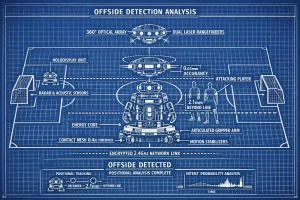
The offside law, as we have discussed at length on this blog, asks a deceptively simple question: at the moment the ball was played, was any part of the attacker’s body — excluding the hands and arms — closer to the opponent’s goal line than both the ball and the second-to-last defender?
The answer, in theory, is either yes or no. In practice, it has become the source of interminable freeze-frames, ghost limbs, dangling armpit debates, and a general erosion of the public will to live.
AMON resolves this with extraordinary precision. Its laser rangefinders measure player positions continuously at 500 frames per second. It is never wrong about the measurement. The measurement, however, is only half the question.
The other half — “the moment the ball was played” — has proven somewhat more challenging.
⚑ Incident — Wuhan, February
AMON identified the precise moment of ball contact as occurring 11 milliseconds earlier than the naked eye would suggest, during which time the striker’s left shoulder had rotated 0.7 degrees forward, carrying his clavicle, and therefore, in AMON’s assessment, a “body part by which a goal can be scored” — 2.1 millimetres beyond the line of the last defender.
The goal was disallowed. The match report noted the crowd’s reaction as “sustained.”
A CFA spokesperson, when asked whether a margin of 2.1 millimetres represented a meaningful competitive advantage to an attacking player, replied that the law does not reference millimetres and that AMON applies the law as written. This is, technically, correct, and has not satisfied anyone.
Law 12: Handball — the law that has defeated humans now defeats machines in new ways
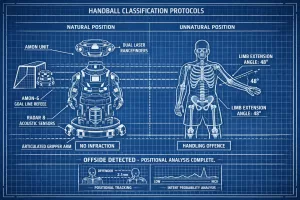
Those who followed our earlier coverage of the handball law will know that its current iteration requires officials to assess, among other things, whether a player’s hand or arm was in a “natural” or “unnatural” position at the moment of contact.
The IFAB has provided guidance on this. The guidance has not, in the years since its introduction, resulted in any two people agreeing on anything.
AMON approaches the problem differently. It has been programmed with a database of 4.3 million biomechanical reference postures, derived from motion-capture data, anatomical studies, and — according to footnote 217 of the technical document — “a representative sample of recreational five-a-side players filmed without their knowledge in Chengdu between 2021 and 2023.”
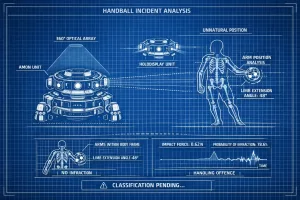
⚑ Incident — Classification Pending
AMON regularly pauses for between 8 and 14 seconds while its processing units complete the biomechanical assessment — during which time the speaker emits a quiet ticking sound that several players have described as “uniquely unsettling.”
On four occasions in the first month of deployment, AMON announced: “handball — classification pending further data.”
In one case, the pending classification was resolved 43 seconds into the next phase of play, at which point AMON-1 retroactively awarded a free kick from a position on the pitch that both teams had long since vacated.
Law 12 (continued): Fouls and misconduct — contact now has a name
Beyond handball, Law 12 governs all fouls and misconduct. AMON’s contact-detection mesh registers every instance of physical contact between players and, within 200 milliseconds, classifies it into one of two categories:
“permitted contact within the laws of the game” or “foul.”
There is no middle ground. There is no “let play continue, it wasn’t much.” There is no need to look at the player’s face to see if they are actually hurt or simply keen to draw attention to themselves.
“AMON had awarded a free kick for a challenge that I would describe as a shoulder barge so mild I’ve seen more aggression in a Post Office queue.”
— Unnamed manager, speaking anonymously
AMON’s post-match data confirmed the contact had registered at 1.7 newtons. The minimum threshold for a foul under its programming is 1.5 newtons.
The manager’s Post Office comparison wasn’t in the system’s reference database, so we couldn’t assess it.
Simulation and diving — the one problem AMON was built to solve, and largely has, except when it hasn’t
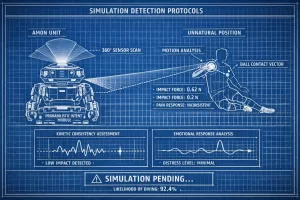
The AMON system includes what the CFA calls its most innovative feature: the Probabilistic Intent-Assessment Module, or PIAM, which is designed to detect simulation — a player deliberately falling, feigning injury, or exaggerating contact in order to influence the match official.
In this respect, the system has performed remarkably well. According to CFA data, simulation has fallen by 71% in AMON-officiated matches. Players have, for the most part, concluded that there is little benefit in throwing themselves to the ground when the entity watching them has no emotional response to theatrical suffering and is logging their exact deceleration rate.
⚑ Incident — The Other Direction
On three separate occasions, players who genuinely twisted ankles or took genuine knocks to the head lay on the pitch while AMON completed its contact-force assessment, calculated that the force applied was insufficient to warrant the observed reaction, and — correctly, in its own terms — declined to stop play.
Two of the three players subsequently confirmed their injuries were real. AMON’s post-match data noted this and logged it as “an outlier event requiring model recalibration.”
The third player has not yet commented publicly. He is recovering well, according to his club.
Laws 15, 16 & 17: Throw-ins, goal kicks, and corner kicks — now absolutely, ruthlessly correct
One area in which AMON has proven unambiguously effective is the administration of restarts. Throw-ins are awarded to the correct team every single time. Goal kicks and corners are similarly exact.
In twelve matches, AMON has made zero errors on restarts.
“The absence of ambiguity in these situations has left them feeling, as one supporter put it, oddly unmoored.”
The VAR problem, or: what happens when AMON-7 gets involved
The AMON system does not use Video Assistant Referee technology in the traditional sense. Instead, when AMON units disagree — which the architects of the system estimated would occur in fewer than 3% of decisions — the matter is automatically referred to AMON-7 for resolution.
In practice, disagreement has occurred in approximately 19% of decisions, a figure the CFA describes as “within an acceptable range of the projected range.”
⚑ Incident — Shanghai, March
AMON-1 awarded a penalty. AMON-6 contested it. Referred to AMON-7, which reversed the decision. AMON-1 re-referred it. AMON-7 confirmed the reversal and instructed AMON-1 to stand down.
AMON-1’s response — a 0.4-second pause followed by a low-frequency emission that engineers later described as “anomalous but non-critical” — was logged but not classified.
The match was delayed by six minutes and forty seconds. No human being had any input into the decision at any point. This is, the CFA noted, the whole idea.
Disciplinary matters: yellow and red cards are now issued with perfect consistency and a mechanical arm
AMON units carry physical cards stored in a slot on the right-hand side of the unit. When a caution or dismissal is warranted, the card is extended via a small pneumatic arm at a height of approximately 1.2 metres. Players must present themselves before the unit to be booked.
Players cannot argue with AMON. Several have tried. AMON does not respond to verbal communication except to re-state the offence category and the player’s squad number.
⚑ Incident — Don’t Touch the Unit
One player, reportedly frustrated by a second yellow card, placed his hand on AMON-1’s chassis. The contact registered at 3.1 newtons. AMON-1 immediately issued a further caution for “physical approach to a match official.”
The player was sent off. His club has since instructed all players not to touch the units under any circumstances.
AMON-4, the fourth official, raises an illuminated board displaying the number of added minutes. The added time is calculated algorithmically based on actual time lost, measured to the second.
In the first month of deployment, the added time has ranged from 1 minute 8 seconds to 11 minutes 52 seconds. There are no round numbers. There is no negotiation.
Post-match data log
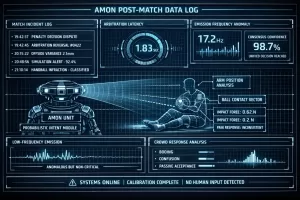
Among the more intriguing sections of the CFA’s technical documentation is the post-match diagnostic log, in which every decision, disagreement and anomaly is catalogued with unnerving precision.
Penalty disputes, offside variances of 2.1mm, simulation alerts at 92.4%, and handball infractions marked simply as “classified” scroll past in a calm, cyan typeface.
Beneath it all, a status bar reads: “SYSTEMS ONLINE | CALIBRATION COMPLETE | NO HUMAN INPUT DETECTED.”
This is presented as a reassurance.
International reaction
“A fascinating and exciting development.”
— FIFA President Gianni Infantino, before boarding a private flight
“Not something currently under active consideration.”
— PGMOL spokesperson, when asked if the Premier League might adopt a similar system. When asked whether it was under passive consideration, the spokesperson said all questions should be submitted in writing.
“I have not heard of the AMON system, and I am going to go and have my lunch.”
— Johan Neeskens, reached by telephone
What this means for the Laws of the Game
As we have argued on this blog before — in the context of the offside law and the handball law in particular — the central problem facing football’s lawmakers is not the rules themselves, but the gap between the rules as written and the rules as applied by fallible human beings working at speed, under pressure, from imperfect angles.
The AMON system closes that gap entirely. It applies the laws exactly as written, every time, without hesitation, without inconsistency, and without any of the contextual human judgment that supporters and analysts have spent decades demanding be removed from the game.
It turns out that contextual human judgement was doing rather more work than anyone had appreciated.
Whether AMON represents the future of football officiating is genuinely unclear at this stage. What is clear is that it represents a future, one in which the decisions are correct, the data is logged, and the 17:42 to Guangzhou will be cancelled without explanation, precisely on time, every single time.
We will continue to follow developments. If AMON issues any statements, we will, of course, report them faithfully. It will not issue any statements. It does not do that.
This is, of course, a spoof article, but you know what they say: “Many a true word spoken in jest”. We already see Premier League referees applying letter of the law decisions, maybe this is not too far from the future truth?
FAQ
What is the AMON robotic referee system?
The Autonomous Match Officiating Network (AMON) is a fully automated refereeing system developed by the Chinese Football Association that uses machine vision and laser tracking to enforce the Laws of the Game without human input.
How does AMON make decisions?
AMON analyses player positions, contact forces and biomechanical data in real time. It applies the laws literally and consistently, even when the outcomes appear unusual to humans.
Is AMON the future of football officiating?
It represents one possible future — one where decisions are perfectly precise but entirely devoid of human judgement. Whether that future is desirable is still up for debate.

John Herman is a Leeds-based, would-be football writer and founder of Football Nonsense. Blending fan passion with sharp opinion, attempting to tackle the game’s biggest debates, from the terraces to the boardroom, with honesty, (attempted) humour, and heart.