Why Birmingham City
Are Called
The Blues.
The nickname is the straightforward part. It is the snuff tin, the Scottish music hall singer, and the winger on a team bus who gave the club something far more interesting than a colour.
There are two kinds of football nickname. The first kind is self-explanatory to the point of being almost not worth explaining; a team that plays in blue gets called the Blues, a team that plays in red gets called the Reds, and so on until football’s imagination runs out, which usually doesn’t take very long.
The second kind has a story behind it, a piece of history that repays the explanation.
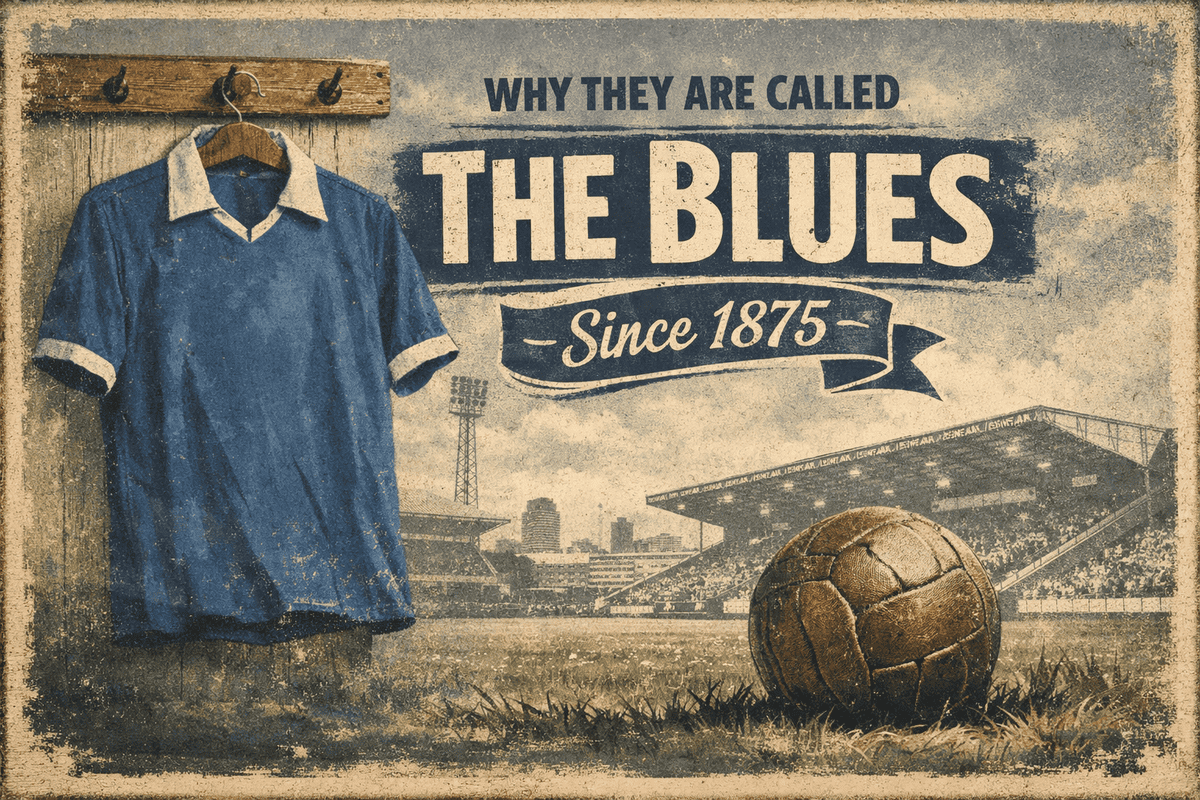
Birmingham City, you’d probably guess, would fall into the first category. They are called the Blues because they do play in blue. They have played in blue since 1875. Nobody ever sat down and made a decision about it. It just was.
And yet. If you spend five minutes with Birmingham City’s history, you find that the nickname, however seemingly obvious, sits on top of something considerably more interesting.
A club that was once called the Heathens. Fans whose name may or may not derive from a tin of snuff. An anthem written in grief by a Scottish music hall comedian that somehow became one of the most recognisable sounds in English football. The Blues is the name. Everything underneath it is the story.
Cricketers, a Church, and a Patch of Waste Ground
Birmingham City were founded in the autumn of 1875 by a group of cricketers attached to Holy Trinity Church in Bordesley Green, on the eastern edge of Birmingham. The story is familiar enough: Victorian and Edwardian football clubs were often the winter project of men who spent their summers with a bat and ball and needed something to do once the season ended.
The club they formed was called Small Heath Alliance, named after the district, and their first match was played in November 1875 on a piece of waste ground off Arthur Street: a 1-1 draw against Holte Wanderers of Aston, a result that has the quality of a historical footnote even though that wasn’t apparent at the time.
Those early sides were known as the Heathens; a nod to Small Heath, and carrying just enough of a roughneck edge to suit a team playing on waste ground and outgrowing one ground after another as the club grew faster than anyone had anticipated. By 1877 they had moved to Muntz Street, their first proper enclosed ground. By 1885 they had turned professional.
By 1888 they had become the first football club in England to register as a limited company with a board of directors, a piece of administrative history that tends to get buried under more colourful stories but which says something about how seriously this club took itself from very early on.
The Heathens’ name quietly faded as the club grew and shed its working-patch-of-ground origins. Small Heath Alliance became Small Heath in 1888. In 1905 the club changed its name to Birmingham, partly to shed its district identity and reach for something grander, partly because the city’s coat of arms made for a better badge than anything else on offer. Birmingham City came in 1943, a wartime administrative change that turned out to be permanent. Throughout all of it, the shirts remained blue, and the Blues remained the Blues.
The Bluenoses: Three Theories and One Tin of Snuff
The nickname for Birmingham City’s supporters — Bluenoses — is rather more contested than the club name itself, and considerably more entertaining as a result.
The most straightforward explanation is the most boring: blue is the colour, a nose is a body part attached to a face, and Bluenose is simply the natural result of someone combining the two. This is probably closest to the truth, and it is also the least satisfying answer, which may be why nobody seems content to leave it there.
The second theory involves a 2003 Football Fans Census survey, which attributed the Bluenose tag to an accusation that Birmingham supporters are, in the survey’s words, “left out in the cold when it comes to success.” Cold noses turning blue. It is something that Birmingham fans have adopted with a certain dark pride, the kind of self-deprecating acknowledgement of a club’s habit of falling just short that supporters of perpetually frustrated clubs tend to develop as a coping mechanism, and perhaps typical of the city’s humour. Whether it is historically accurate or not is a different question.
The third theory is perhaps the best one, even if it can’t be fully verified. According to a version of events that has circulated among supporters for decades, the Bluenose name derives from an attempt in the 1920s to market a product called Birmingham Blues Snuff. The product, and the ritual of snorting the powder, apparently left a blue deposit across the middle of the supporter’s face. Hence: Bluenoses.
Whether or not this is true, it has the feel of an urban myth that may have grown somewhat over the years; it is the version most worth repeating, and it has the distinct advantage of being utterly unlike any other explanation for a supporter’s nickname in English football.
Birmingham City were founded in September 1875 as Small Heath Alliance — making them 151 years old and counting.
They were the first football club in England to register as a limited company, in 1888.
The club has gone through five names: Small Heath Alliance, Small Heath, Birmingham, Birmingham City, and, for one match only in 2022, as a nod to Peaky Blinders, Small Heath Alliance again.
St Andrew’s has been their home since 1906. The ground’s current official name is St Andrew’s @ Knighthead Park, following the 2023 takeover by Knighthead Capital Management.
Birmingham City won the League Cup in 1963 and 2011. The 2011 final victory over Arsenal remains the club’s most recent major trophy.
Keep Right On: The Saddest Song in Football, Sung With the Most Joy
If the Blues nickname is the straightforward part of Birmingham City’s identity, and the Bluenose origin is the murky and entertaining part, then Keep Right On is the part that genuinely sets the club apart from almost every other team in England.
The song’s origins have nothing to do with football. It was written by Sir Harry Lauder, a Scottish music hall performer born near Edinburgh in 1870 who became one of the most internationally celebrated entertainers of his day. Lauder wrote Keep Right On To The End Of The Road in 1924, on a railway carriage, as a tribute to his son John, who had been killed in action during the First World War.
It was a song of grief dressed up as a song of perseverance, and when Lauder first performed it at the Victoria Palace Theatre in London, an audience member is said to have risen to declare it a sermon on the stage.
The connection to Birmingham City came thirty years later and in the most accidental of circumstances.
During the 1955-56 FA Cup run, winger Alex Govan, a Glaswegian who had come to Birmingham via Plymouth Argyle, was on the team bus heading to a cup tie when manager Arthur Turner asked him for a song from Scotland. Govan could not think of anything more appropriate, so he sang Keep Right On. The squad took to it. The supporters took to it. By the time Birmingham reached the 1956 FA Cup Final at Wembley, which they lost to Manchester City, it had become the sound of the club.
Arthur Turner turned and said: “Come on Alex, give us something from Scotland.” I couldn’t sing “I Belong to Glasgow”, so I sang “Keep Right On to the End of the Road” — it was the easiest one to sing.
Alex Govan, on the song that defined a club
There is something quietly extraordinary about this. A song written in memory of a young man killed in the First World War, composed by a Scottish comedian on a train, adopted by a football club in Birmingham because a winger from Glasgow could not think of anything else to sing — and it has now been ringing around St Andrew’s for the better part of seventy years.
Birmingham fans sing it at kick-off and at moments of triumph and in the darkest stretches of difficult seasons, and it carries a weight that most football anthems simply do not have.
You’ll Never Walk Alone is perhaps the obvious comparison, but even that was written as a song. Keep Right On was written as a private act of mourning. The fact that it became public property, and Birmingham’s property specifically, is one of football’s stranger and more moving accidents.
What the Name Has Had to Survive
Being a Bluenose has rarely been straightforward. Birmingham City are a club that has spent much of their history in the shadow of Aston Villa, their neighbours, their rivals, the team that has historically attracted the greater share of regional attention and silverware. The Second City derby is one of English football’s more ferocious local rivalries, largely because it has historically been so lopsided in Villa’s favour that Birmingham supporters have needed the ferocity to compensate.
The club’s recent history has been particularly testing. A chaotic period of ownership under Carson Yeung ended in a criminal conviction. The sale to Birmingham Sports Holdings led to years of financial turbulence and, in 2023, League One relegation, sending the club to the third tier for the first time in decades. New American owners, Knighthead Capital Management, arrived in 2023 and oversaw an immediate League One title in 2024-25, bringing Birmingham back to the Championship; back, in other words, to where a club of this size and support expects to be, with visions of going even further.
Through all of it, the anthem kept going. That is perhaps what Keep Right On does best; it was written for exactly this kind of endurance, and Birmingham supporters have had more occasion than most to test it. The hashtag #KRO has been a fixture on Blues social media through administrations, relegations, and ownership crises alike. It is the sound of a fanbase that has decided, against considerable evidence, to keep going anyway.
Which is, when you think about it, exactly what Harry Lauder had in mind.
Previously: Why Wrexham AFC are called the Red Dragons — and what happens when a nickname becomes a rebrand.
Next: Why Sheffield Wednesday are called Owls It’s not as obvious as you think

John Herman is a Leeds-based, would-be football writer and founder of Football Nonsense. Blending fan passion with sharp opinion, attempting to tackle the game’s biggest debates, from the terraces to the boardroom, with honesty, (attempted) humour, and heart.