
Why Are Sheffield Wednesday
Called The Owls.
A club named after a day of the week, a nickname stolen by their fiercest rivals, and an owl that, strictly speaking, was never actually a bird in the first place.
Sheffield Wednesday have one of the strangest names in English football before you even get to the nickname. Most clubs are named after a place, a saint, or a sponsor. Wednesday are named after a day of the week, and not for any romantic reason, but because of nineteenth-century shop opening hours. The nickname that came later, the Owls, has its own twist in the tale, and it turns out the bird on the badge may not be quite what generations of fans have assumed it to be.
The club’s origins lie in the Wednesday Cricket Club, formed by Sheffield tradesmen back in 1820. The trading laws of the period required shops and businesses to close for half a day during the working week, and in Sheffield most chose Wednesday afternoon.
With an unexpected pocket of free time on their hands, the cricketers wanted a way to stay fit through the winter months, and in 1867 they formed a football side to do exactly that. It simply took the name of the day they always played. The Wednesday Football Club. Nobody dressed it up as anything grander, and the name has survived, more or less unchanged, for a century and a half.

The Nickname They Lost to Their Rivals
Long before the Owls, Wednesday were known by a different name entirely — the Blades, a nickname that, at the time, simply belonged to any sporting team from Sheffield, a city whose worldwide reputation rested on cutlery and steel. Wednesday, as the senior and more established club in the town through the 1870s and 1880s, had every reason to consider the nickname theirs by right.
Then, in 1889, a rent dispute over Bramall Lane led to the formation of a rival club entirely — Sheffield United, assembled by the very committee Wednesday had fallen out with. United took the ground. United also took the nickname. The Blades nickname belongs to Sheffield United to this day, a small but pointed reminder, every Steel City derby, of a nineteenth-century falling out over the small matter of pitch fees.
Owlerton, and the Owl That Took Its Time
Forced to find a new home after railway expansion had swallowed their previous ground, Wednesday moved in 1899 to a patch of land in a district then known as Owlerton, on the north-west edge of the city. The new stadium took the area’s name. It would later become known as Hillsborough, but for the first years of the twentieth century, Wednesday were simply the team from Owlerton.
It is widely assumed that the Owls nickname followed immediately from that move — Owlerton to Owls feels like an obvious step. The actual history is slower and a little stranger.
The club had already tried a mascot once, a monkey, which by all accounts did the team no favours whatsoever. It was not until 1912, when a Wednesday player named George Robertson presented the club with an owl, that the nickname properly took hold. Whether it was the bird itself or simply better timing, the Owls went on an excellent run of results, and the name stuck where the monkey never had.
A monkey mascot introduced some years earlier had not brought much luck.
Wikipedia, on Sheffield Wednesday’s brief and unsuccessful primate era
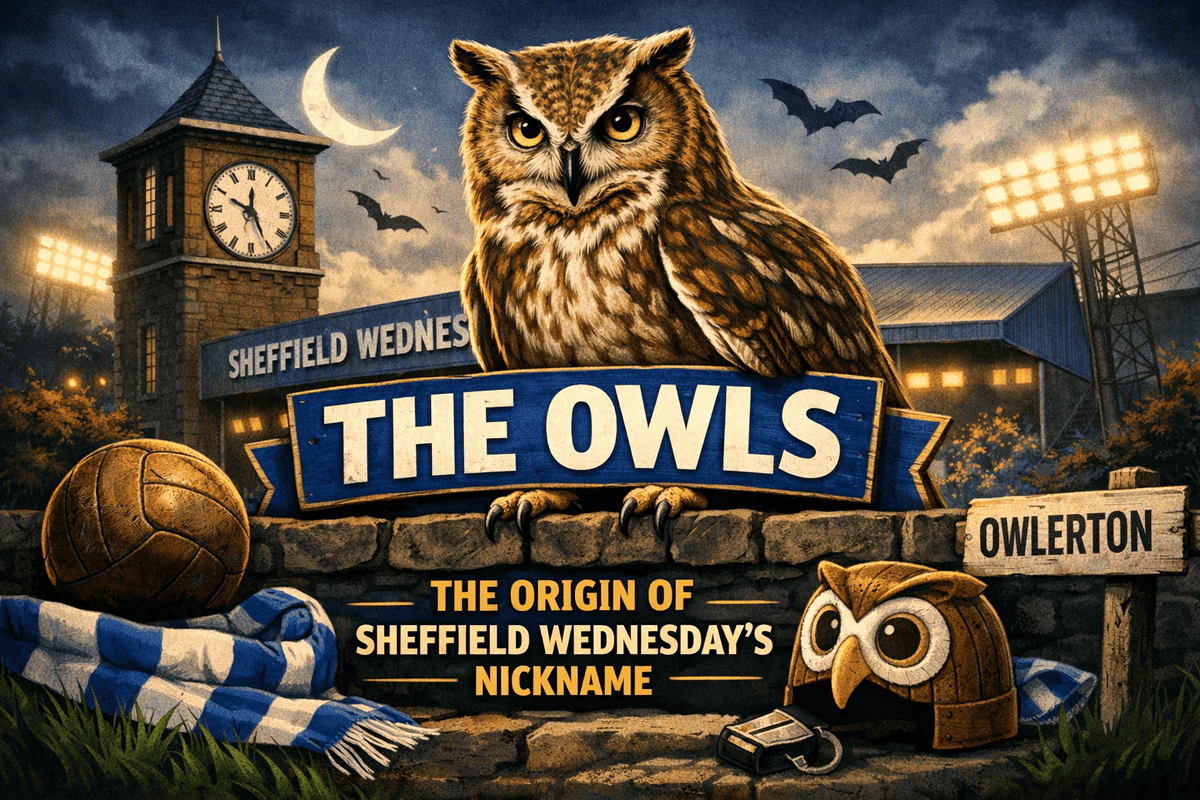
The Twist: It Was Never About the Bird
Here is the detail that even long-standing Wednesday supporters are often surprised to learn. The “Owl” in Owlerton has nothing to do with the bird at all. In old Yorkshire dialect, “owler” or “owl” was a word for the alder tree — a species that grew in abundance in the woodland around that part of Sheffield.
Owlerton was, in the most literal sense, alder-tree-town. The owl on Sheffield Wednesday’s crest, depicted for over a century perched proudly on a branch, is a wonderfully confident piece of branding built on what was, originally, a simple mistranslation of a place name.
Nobody at the club seems to have minded. By the time anyone worked out the etymology, the owl was already on the badge, already on the mascot, already embedded in terrace chants and supporter forum names. A mistranslated tree became one of the most recognisable bird emblems in English football, which is a more honest description of how nicknames actually work than most clubs would care to admit.
Sheffield Wednesday were formed in 1867 from the Wednesday Cricket Club, itself dating to 1820 — making Wednesday the second-oldest professional association football club in England.
The club were originally known as the Blades, a nickname later claimed permanently by Sheffield United after the 1889 split.
The Owls nickname is widely linked to the 1899 move to Owlerton, but only properly took hold in 1912 after player George Robertson presented the club with an owl mascot.
“Owler” is an old Yorkshire dialect word for the alder tree — meaning Owlerton’s name, and Wednesday’s nickname, has no original connection to the bird at all.
A Name Built on Half-Day Closing and a Mistranslation
There is something quietly brilliant about a major English football club whose identity rests on two accidents of history — a Victorian trading law that happened to give a group of cricketers Wednesday afternoons off, and a dialect word for a tree that got mistaken for a bird. Neither was planned. Neither was the product of a marketing committee or a fan vote. They simply happened, the way most good nicknames do, and the club built everything else — the badge, the mascot, the songs — on top of them afterwards.
Wednesday have been through a great deal in their long history, and recent years have tested supporters as much as any in the club’s past. But the Owls have outlasted boardroom chaos before, just as the nickname outlasted the Blades, the monkey, and a basic misunderstanding about trees. There is a kind of resilience in a name that was never really about what everyone assumed it was about in the first place.
Previously: Why Wrexham are called the Red Dragons — and how a marketing brief became a global identity.
Next: Why Bolton are called the Trotters — which of the four theories is true?

John Herman is a Leeds-based, would-be football writer and founder of Football Nonsense. Blending fan passion with sharp opinion, attempting to tackle the game’s biggest debates, from the terraces to the boardroom, with honesty, (attempted) humour, and heart.