

Analysis
Is The Offside Law Broken?
Here’s How We Might Fix It.
Technology promised football precision. Instead, it delivered armpit offsides, four-minute reviews, and the slow erosion of common sense.
IFAB held its latest annual meeting earlier this month, and the headlines were again about time-wasting. Building on last year’s change to cap how long goalkeepers can hold the ball, the 140th AGM extended the countdown principle to throw-ins and goal kicks, and agreed to conduct further trials on tactical injury delays. Tidy, practical, uncontroversial. The sort of thing that generates a round of applause at a governing body meeting and changes precisely nothing about anything that’s actually broken. Of course, it is important to consider this sort of thing, but perhaps the real effort should be aimed at the more crucial laws of the game that are currently causing the most frustration for clubs, players, and, of course, fans.
It’s the offside law, the rule that has produced armpit decisions, four-minute VAR reviews, and a rolling philosophical crisis about what fairness in football even means, which appears to continue to sit in the in-tray marked “ongoing trials.” The people in charge of the game are very busy counting down the seconds a goalkeeper holds the ball. They appear to be less interested in addressing why a stadium full of people can watch a goal go in, celebrate it, and then have it taken away two minutes later because a player’s shoulder was fractionally ahead of a defender’s.
To be fair, IFAB did confirm it would proactively identify competitions to conduct additional offside trials, with a view to promoting attacking football and encouraging goalscoring opportunities, but trials are not decisions. They are a way of being seen to act while avoiding the commitment of actually acting. The daylight rule, a straightforward fix with broad support, has been discussed, trialled, and nodded at for years. But it is still not the law.
Time-wasting is an irritant. The offside law is a structural problem. It is worth asking why one of those things keeps getting fixed, and the other keeps getting studied.
Football has always generated arguments. It always will. A dodgy penalty call, a tackle that could have gone either way, a goal that looked suspiciously like a push, these are the disputes that spill out of grounds and into pubs, that fill phone-in shows, that keep the sport alive in the spaces between matches, and one of the reasons we love the game so much. Controversy, at a certain level, is part of the furniture.
But there is a difference between controversy and absurdity. And the offside law, in its current form, has crossed firmly into that territory.
We are now six years into the Premier League’s VAR experiment, and rather than resolving the offside debate, the technology has made it stranger, more frustrating, and, if we are being honest, philosophically incoherent. The rule designed to prevent players from gaining an unfair advantage is now regularly used to punish players who had no meaningful advantage whatsoever. The machine has been given authority it was never equipped to handle, and the game is suffering as a result.
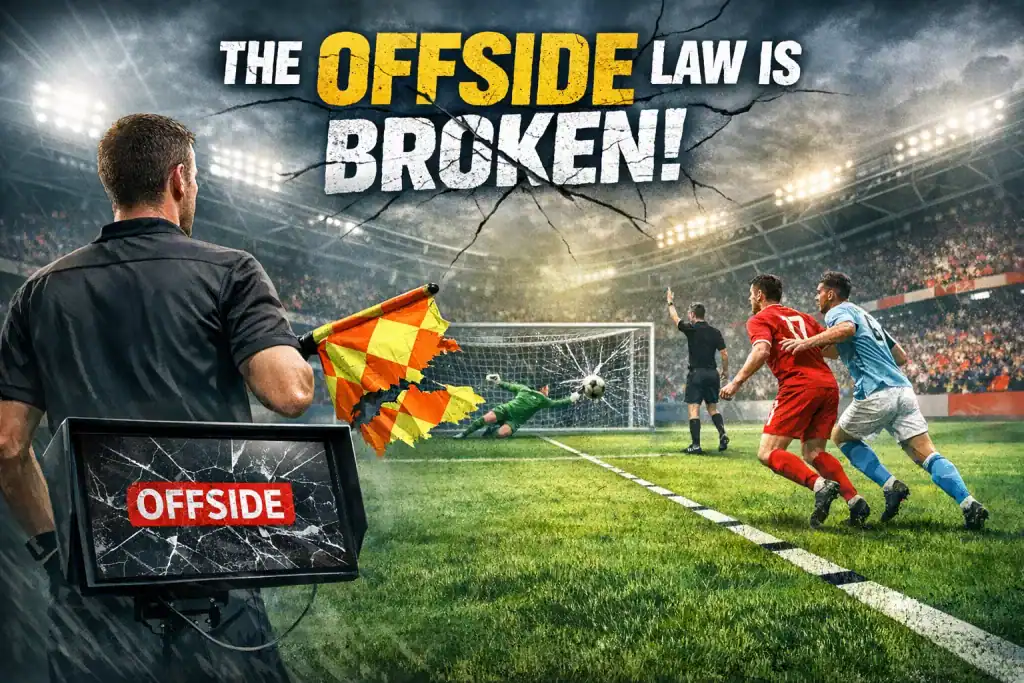
What the Rule Was Always Meant to Do
The offside law is not complicated in principle. It exists to prevent goal-hanging, to stop a striker from loitering between the goalkeeper and the goal, waiting passively for a through ball that their teammates can pick out at leisure. The offence is about gaining an unfair advantage from an advanced position.
That word, unfair, is doing a lot of work. For most of football’s history, it was applied with something approaching common sense. A player two or three yards ahead of the last defender, in a clear goalscoring position, level with or behind the defence, these were the scenarios that mattered. A linesman’s flag, an imperfect human judgment, a reasonable interpretation of a fast-moving situation.
Nobody pretended the system was perfect. Goals were occasionally given that shouldn’t have been, and vice versa. But the margin of error was broadly proportional to the actual advantage a player could extract from being an inch or two ahead of a defender. Which is to say: almost none.
Where It All Went Wrong
VAR arrived with a promise: we will get the big calls right. Offside seemed like an easy win. Replace the fallible linesman’s flag with a semi-automated tracking system, draw two lines on the screen, and the question of whether a player is or isn’t ahead of the last defender becomes a matter of record rather than opinion.
In practice, it has been a different story entirely.
Consider what happens when VAR reviews an offside decision today. The footage is paused at the precise moment the ball is played. Lines are drawn from the outermost extremity of the attacker’s body and matched against the last defender. The review can take two or three minutes, sometimes nearly four. And at the end of it, a stadium full of people is presented with a freeze-frame image in which the margin separating a goal from no goal is, in some cases, a collarbone. A shoulder. An armpit.
A selection of the VAR era’s most contested calls:
- Firmino vs. Aston Villa — 2019 The first ‘armpit offside’ of the VAR era. Roberto Firmino’s goal was chalked off because the tip of his armpit extended beyond the last defender.
- Elanga vs. Aston Villa — 2024 Anthony Elanga’s shoulder was ruled offside, wiping out what would have been a Chris Wood equaliser for Nottingham Forest. Gary Lineker’s response: “How they can judge from that shoulder incident, I will never know.”
- Luis Díaz vs. Tottenham — 2023 A new low entirely — a goal wrongly disallowed not because the technology failed, but because of a communication breakdown between VAR officials who had somehow convinced themselves the on-field decision had already been a goal. Liverpool were robbed of a point they were entitled to keep.
- Lundstram’s toe — Sheffield United A goal was disallowed because John Lundstram’s big toe was a centimetre or two ahead of a defender. On the right wing. In the build-up. A decision technically correct according to the letter of the law, and completely contrary to its spirit.
The Precision Problem
Here is the fundamental issue: the technology is being asked to make binary decisions, namely offside or onside, within margins that exist inside the system’s own margin of error.
The semi-automated offside tool works by tracking skeletal data points from broadcast camera footage and projecting them onto a virtual 3D model. The accuracy of this system, at its very best, is somewhere in the region of a few centimetres. Yet we regularly see decisions made based on body parts less than that distance from the last defender.
What meaningful advantage was gained there? The honest answer is none. The player was not in a better position to receive the ball or score because of that toe.
The case of Lundstram’s big toe, Sheffield United
This is not a problem of referees getting calls wrong. This is a problem of the law generating outcomes that make no sporting sense.
The Daylight Standard: The Fix That’s Sitting Right There
The most practical, most elegant solution to the marginal offside problem already has a name and broad support — it just lacks the political will to implement it.
This is not a radical departure. It is, in essence, a return to the law’s founding logic. The rule was written to catch players who were clearly, meaningfully ahead of the defence. It was not written to catch armpits.
Under a daylight standard, the Elanga shoulder call stands. The Lundstram toe goal counts. The Firmino armpit goal stands. And crucially, the actual offside rule, the one that prevents a striker from camping in front of the goalkeeper, the one that makes defensive lines possible, remains fully intact, because genuinely offside players are not affected by this change at all.
It also has an enormous practical benefit: speed. VAR offside reviews currently take an average of over 2 minutes, with some stretching to 3 or 4 minutes. Under daylight conditions, marginal calls are resolved in seconds because, if it is not obvious, it is not offside. If IFAB are so focused on saving time in a game, here’s a quick win.
What About ‘Interfering With Play’?
There is a second strand to the offside problem that is arguably even murkier: the concept of a player in an offside position interfering with play without directly receiving the ball.
Recent seasons have produced a parade of disallowed goals where the scorer was onside, the goal was genuine, but somewhere in the build-up, a cross, a pass, a moment of movement, a teammate was in an offside position that the referee judged to have affected a defender or goalkeeper.
The Virgil van Dijk disallowed goal against PSG in 2024/25 was ruled out because Andrew Robertson was in an offside position and supposedly impacted Donnarumma’s ability to deal with the shot. Dermot Gallagher’s verdict on Sky Sports’ Ref Watch was telling: “It’s open to interpretation.” That phrase, open to interpretation, is doing a lot of heavy lifting in a system that was supposed to eliminate subjectivity.
These decisions are inconsistently applied, almost impossible to predict, and frequently produce outcomes that look nothing like justice from the stands. They are a separate but related symptom of the same disease: a law that has grown too complex to be enforced coherently. Managers, players, pundits, and fans are constantly calling out for consistency in the application of the rules, but with such ambiguous laws that are “open to interpretation”, we have no chance. Each official will interpret the law in their own way
The offside rule needs two things: a clearer standard and the honesty to admit that precision and fairness are not the same thing.
Technology has enabled football to measure marginal offsides to the centimetre. What it has not given football is any reason to believe that centimetre-level precision produces fairer results than a reasonable human judgment. In many cases, it produces worse ones, more divisive, more time-consuming, less intuitive, and harder to explain to the person sitting next to you in the ground.
The daylight rule is not perfect. No rule is. There will still be cases where it is hard to tell. But it sets a standard that is proportional to the advantage being gained, delivers results in a fraction of the current review time, and produces decisions that most fans will recognise as just, even when they go against their team. How many times did you hear this season, when watching the early rounds of the FA Cup, pundits, fans, and just about everyone who takes an interest in the game say how refreshing it was to watch a game without VAR? (The officials seemed to have a bit of struggle without it, but that’s another conversation)
IFAB has the tools to fix this. The offside law does not need to be scrapped; it needs to be recalibrated. The game was never meant to hinge on an armpit. It is time to stop pretending otherwise.

John Herman is a Leeds-based, would-be football writer and founder of Football Nonsense. Blending fan passion with sharp opinion, attempting to tackle the game’s biggest debates, from the terraces to the boardroom, with honesty, (attempted) humour, and heart.