
Why Charlton Are Called
The Addicks.
A fish supper, a South London accent, and a man waving a haddock on a stick. The story behind one of English football’s most inexplicable nicknames.
If you were asked to guess the origin of Charlton Athletic’s nickname, you would probably take a while to get there. The Addicks. It sounds vaguely like a portmanteau, or possibly something to do with the word Athletic, or perhaps a piece of south-east London slang whose roots have been lost to time. None of those guesses would be right. The real story involves a fishmonger, a post-match meal, and a South London accent doing what South London accents do.
Charlton Athletic were formed in 1905 — not by a church, a factory, or a cricket club, as so many Victorian and Edwardian football clubs were, but by a group of local teenagers who had been kicking a ball around the streets near the Thames and decided to make it official. The meeting at which the club was formally founded took place at a shop on East Street in Charlton. The shop belonged to a fishmonger named Arthur Bryan.
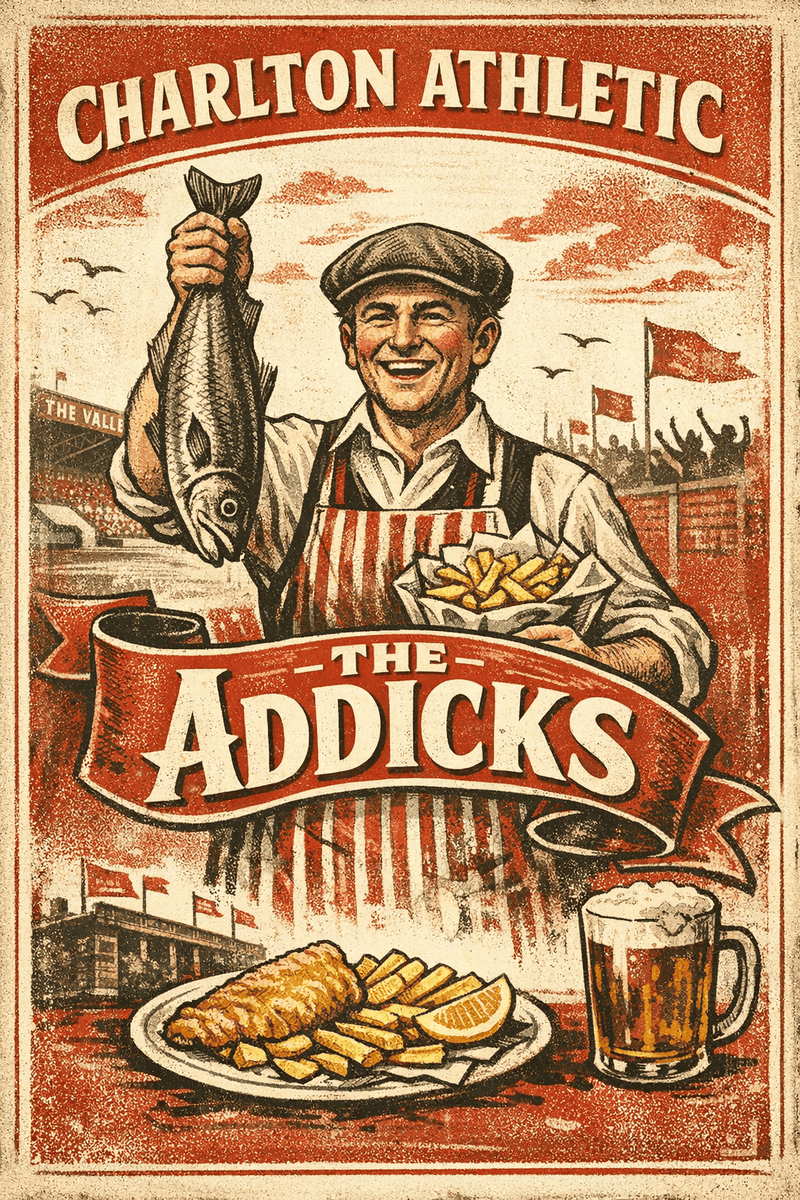
Enter Arthur Bryan
Arthur Bryan — known locally as “Ikey” — was not merely a witness to Charlton Athletic’s birth. He was, by all accounts, one of its more enthusiastic early supporters, a man who took the fledgling club to heart from the moment it was formed on his premises. His shop at 77 East Street sat in the heart of the neighbourhood from which Charlton Athletic drew their earliest players and fans, and Bryan positioned himself — literally — at the centre of the club’s social life.
After matches in those early, pre-professional years, it became something of a tradition for players from both sides to take a post-match meal at Arthur’s shop. Haddock and chips, served to the winning and losing sides alike, the kind of working-class ritual that would have been utterly unremarkable in south-east London in the first decade of the twentieth century. Except that in the South London dialect, haddock doesn’t quite sound like haddock.
In speech, haddock developed into ‘addicks’ in South London dialect, where the ‘h’ would in any case be dropped as a matter of course, and the ‘o’ has become corrupted to ‘i’ with lazy usage — the most common form of language development.
The Beautiful History, on the origins of the nickname
So the players went for their ‘addick and chips. And the name, delivered with the particular rhythms of south-east London speech, began to stick.
The Man with the Haddock on a Stick
If Arthur Bryan had merely fed the players after games, the story would be charming enough. But Bryan was also, by contemporary accounts, something of a showman. He attended Charlton matches as a supporter and as an advertisement for his shop simultaneously, turning up with a haddock nailed to a piece of wood and waving it at the crowd while shouting his wares. An early example of pitch-side marketing, delivered with considerably more commitment than a modern LED hoarding.
The local press — specifically the Kentish Independent — were documenting the club’s progress through the Lewisham and Woolwich leagues, and by 1908 their cartoonists had started referring to the team in print. The very first such cartoon, from October 31st of that year, calls the team the Haddocks. By 1910 the name had softened in the telling into Addicks, and from there it was fixed. When Charlton appeared in the Woolwich Cup Final in 1909, Bryan was by all accounts particularly vocal in the stands, his haddock-on-a-stick advertisement doing double duty as a rally point for supporters.
The first documented reference to the team as “The Haddocks” appeared in the Kentish Independent on 31 October 1908 — three years after the club’s formation.
By 1910 the spelling had evolved to “Addicks” in the local press and has remained so ever since.
Arthur Bryan’s shop at 77 East Street — now Eastmoor Street — was the venue at which the club was formally founded on 9 June 1905.
Charlton have also been known as the Robins (from 1931) and the Valiants (chosen in a fan competition in the 1960s), but neither nickname seriously challenged the Addicks.
A Nickname That Nearly Disappeared
The Addicks became so embedded in the club’s identity that it survived even a period when the club itself adopted an entirely different nickname. In 1931, Charlton briefly rebranded as the Robins — a change reflected in the club badge at the time, and in the song the players still walk out to today, When the Red, Red Robin Comes Bob, Bob, Bobbin’ Along. Then in the 1960s, a fan competition produced yet another alternative: the Valiants, a nod to The Valley and reflected in the sword badge that remains on the club crest.
Neither one took lasting hold. The Addicks, improbable and inexplicable to anyone outside south-east London, proved more durable than either. When Charlton were forced to leave The Valley in 1985 — ground-sharing at Crystal Palace’s Selhurst Park for seven years in one of English football’s stranger periods — the nickname went with them into exile and came back when the club did in 1992. It had outlasted the ground itself.
There is something fitting about that. Nicknames rooted in place and community tend to endure in ways that more carefully chosen ones do not. The Addicks was never the product of a branding exercise or a committee decision. It emerged from a fish supper, a South London accent, and a man who was very enthusiastic about selling haddock. That is not a bad foundation for 120 years of identity.
Next: Why Exeter City are called the Grecians — and what an ancient siege has to do with a football club in Devon.

John Herman is a Leeds-based, would-be football writer and founder of Football Nonsense. Blending fan passion with sharp opinion, attempting to tackle the game’s biggest debates, from the terraces to the boardroom, with honesty, (attempted) humour, and heart.