
Why Exeter City Are Called
The Grecians.
A parish outside the city walls, an ancient siege, and a nickname that has baffled football fans for over a century. The story goes back further than you think.
Ask most football fans why Exeter City are called the Grecians and you will get a shrug, a guess involving Greek immigrants, or a vague reference to the university. None of those answers are right. The real explanation is older than the football club by several centuries, rooted in the peculiar social geography of a Devon city, and connected — at least in local legend — to the siege of Troy. It is, by some distance, the most improbable origin story in the English football pyramid.
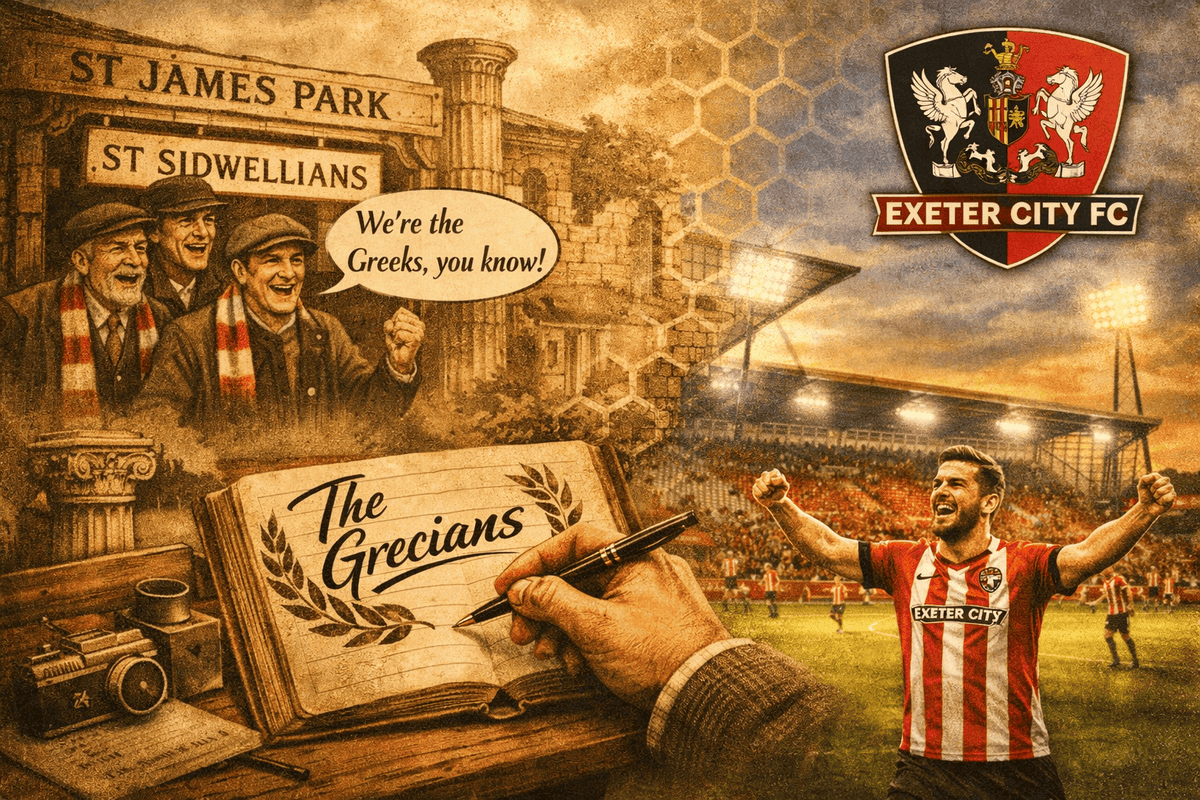
Exeter City were founded in 1901, growing out of a local side called St Sidwell’s United who played their early matches just outside the old city walls. The area they came from was the parish of St Sidwell’s — and the people of St Sidwell’s had been known by a particular name for as long as anyone could remember. Long before a football club existed, long before there was a ground to play at, the residents of that parish were called the Grecians.
Inside the Walls and Outside
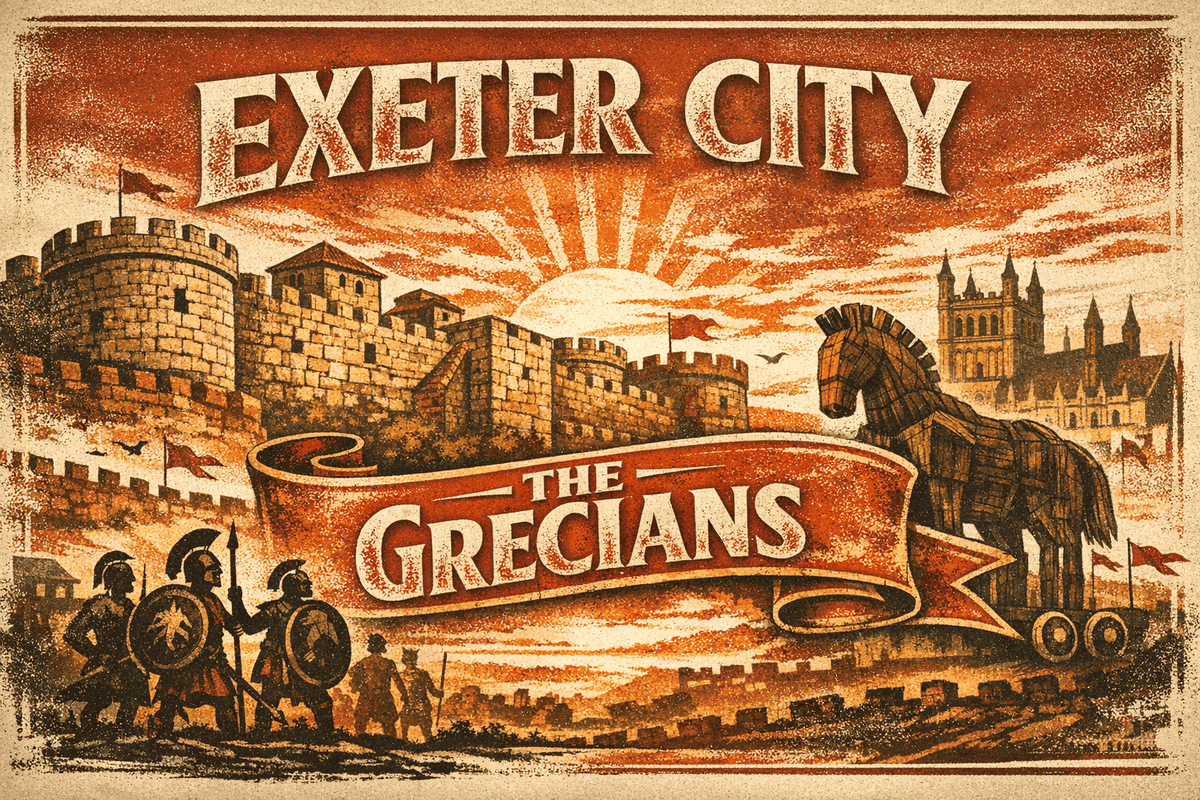
To understand the nickname you have to understand the geography. Exeter is a city with ancient Roman walls that still largely stand today, and for much of its history those walls defined everything. The people who lived inside the walls were the city’s elite — the wealthy, the established, the politically powerful. They were sometimes referred to, informally, as the Romans, a nod to the settlement’s origins and to those who controlled it.
The people of St Sidwell’s lived outside those walls. They were the outsiders in a quite literal sense — a large and numerous parish, but one whose claim to full citizenship was considered doubtful by those within the city. And somewhere in the long history of that social division, the outsiders of St Sidwell’s began to identify themselves with another group of famous outsiders: the Greeks besieging Troy.
The connection appears in documented form as far back as 1669, when an administrative record refers to the “Grecians of the Parish of St Sidwell’s.” By 1726, the association had become concrete enough to stage: a re-enactment of the siege of Troy was held in Southernhay, with the parishioners of St Sidwell’s playing the parts of the Greeks. Charles Dickens, writing in 1865, recorded that the young people of St Sidwell’s were still being called Grecians — describing street battles between parish gangs in terms that made the old identity vivid and real.
There was a remote parish — that of St Sidwell’s — the claims of whose boys to the right of citizenship were doubtful. They were contumaciously called Grecians; but the parish being large, and its warriors numerous, the citizen lads were accustomed to combine against the outer barbarians.
Charles Dickens, All the Year Round, 1865
By the time a football ground was opened at the end of Sidwell Street, the name was so embedded in local life that it was given to the gate at the end of the road: the Grecian Gate. The team that played there — St Sidwell’s United, later to become Exeter City — inherited it as naturally as they inherited the ground itself.
From Parish Identity to Football Club
When Exeter City turned professional in 1908, the question of a permanent nickname was put formally to supporters. The Football Express ran what amounted to an informal ballot, receiving more than 200 suggestions. The editor’s verdict was decisive: the Grecians had the most to recommend it, because it was already what the people of St Sidwell’s had always been. It was not chosen so much as recognised.
The club changed its name from St Sidwell’s United to Exeter City in 1904, but the nickname came with it unchanged. There is something quietly remarkable about that — a club shedding its original name and identity while holding on to the community label that predated both. The Grecians was never a marketing decision. It was simply what the people in that part of Exeter had always been called.
The earliest documented reference to St Sidwell’s residents as “Grecians” dates to 1669 — over 230 years before Exeter City were founded.
A re-enactment of the siege of Troy was staged in Exeter in 1726, with St Sidwell’s parishioners playing the Greeks.
Charles Dickens wrote about the Grecians of St Sidwell’s in 1865, describing them as the “outer barbarians” relative to the walled city.
Exeter City became the first English club to play a national team in Brazil, during a groundbreaking South American tour in 1914.
A Nickname Nobody Can Fully Explain
What makes the Grecians story genuinely unusual — even among the oddities of English football nicknames — is that nobody can say with complete certainty why the people of St Sidwell’s were called Grecians in the first place. The siege of Troy theory is the most widely accepted, and it has the virtue of explaining both the name and the spirit of it: outsiders who defined themselves against those within the walls. But it is folklore rather than established fact.
Other theories exist. Some historians point to a significant Orthodox community in the area with Greek connections. Others suggest the name may derive from the parish’s position outside the Roman settlement — Greeks to the city’s Romans in a more general cultural sense. A few sources mention the word “greasy ‘uns” as a possible corruption, though that particular theory has not found many supporters.
The honest answer is that the origin has been lost to time, and the uncertainty is part of the charm. A nickname this old was never going to arrive with a paper trail. It emerged from the texture of a city’s social life, passed between generations without needing explanation, and eventually found its way onto a football shirt. That it belongs to a League One club in Devon, rather than some grand metropolitan institution, makes it all the more singular.
The Grecians have been besieging the city walls for over three hundred and fifty years. A football club is just the most recent chapter.
Previously: Why Charlton Athletic are called the Addicks — and the fishmonger who started it all.
Next: Why Brentford are called the Bees — and the misheard chant that gave a club its identity.

John Herman is a Leeds-based, would-be football writer and founder of Football Nonsense. Blending fan passion with sharp opinion, attempting to tackle the game’s biggest debates, from the terraces to the boardroom, with honesty, (attempted) humour, and heart.
Good read as usual