

Why Wrexham Are Called
The Red Dragons.
They were once the Sugar Bags. Then the Robins. The Red Dragons arrived in 2001 via a commercial manager with a spreadsheet and a marketing brief. The oldest club in Wales deserves a better origin story than that. Or does it?
Most football nicknames grow organically — a fishmonger waves a haddock, a journalist mishears a chant, a parish outside the city walls borrows an identity from an ancient siege. They arrive by accident, stick through habit, and outlast everyone who was there at the beginning. Wrexham’s nickname arrived differently. The Red Dragons seems like an obvious choice for a team rooted in Wales, but the name was apparently the product of a commercial manager, a marketing brief, and a fan ballot held in 2001. They were, in the most straightforward sense of the term, invented.
That might sound like a reason to dismiss them. It isn’t. The story of how the world’s oldest international football stadium came to be associated with a dragon is more interesting than it first appears — and it is inseparable from a club history that stretches back to 1864, encompasses three previous nicknames, a spell in blue and white, and one of football’s most remarkable modern reinventions.
Before the Dragons: Sugar Bags and Robins
Wrexham AFC were founded in 1864 — not, as is often assumed, by a church or a factory, but by members of Wrexham Cricket Club looking for something to do in winter. Edward Manners, secretary of Denbighshire County Cricket Club, proposed the idea at an end of season dinner, and the club that would become the oldest professional football team in Wales was born from a conversation about how to fill the colder months.
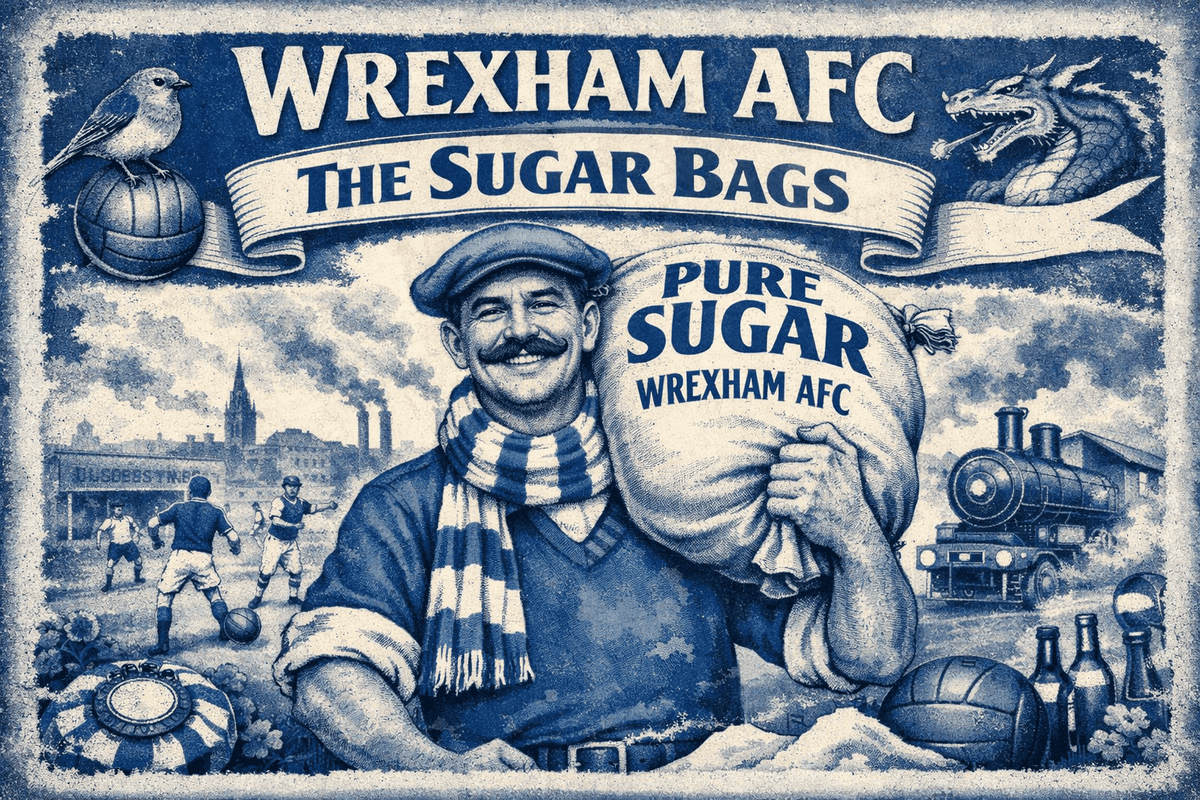
For most of their first seventy-five years, Wrexham played in blue and white and were known informally as the Sugar Bags — a reference to the blue and white striped packaging of sugar at the time, which their kit closely resembled. It is not the most distinguished nickname in football history, but it was theirs, and it stuck through decades of local league football as the club gradually built a proper identity.
In 1939, everything changed. Wrexham switched to red — a colour they have worn ever since — and with the new kit came a new nickname. The Robins, named in honour of Ted Robinson, the club secretary who had managed the team between 1912 and 1924 and was later inducted into the Wrexham Hall of Fame. It was a neat piece of naming: red shirts, a robin’s red breast, and a nod to a man who had shaped the early professional club. The Robins served Wrexham well for sixty years.
The Problem with Being a Robin
By the turn of the millennium, Wrexham’s commercial manager had a problem. The Robins was a perfectly serviceable nickname, but it was also the nickname of Bristol City, Swindon Town, and Cheltenham Town. For a club trying to build a distinctive Welsh identity and attract sponsorship on that basis, sharing a nickname with three English clubs was a genuine obstacle.
The solution arrived in the 2001–02 season, when the Red Dragons nickname was introduced alongside a fan ballot and a new club mascot, Wrex the Dragon. The timing was deliberate — Wrex made his debut on 4 August 2001, when Wrexham played Manchester United in a testimonial match at the Racecourse Ground, giving the new identity maximum visibility from the outset.
The mascot, along with the team nickname the Red Dragons, was introduced in the 2001–02 season in order to help promote the club and broaden the club’s Welsh image — to better differentiate the club from Bristol City, Swindon Town and Cheltenham Town, who had the same nickname.
Wikipedia, on the origins of the Red Dragons nickname
The logic was sound even if the method was clinical. Wrexham are the oldest club in Wales, play at the world’s oldest international football stadium still in use, and compete in the English football pyramid while remaining deeply rooted in Welsh identity. The red dragon — Y Ddraig Goch — is the central symbol of the Welsh flag, one of the oldest national flags in the world. Connecting the club to that symbol was not an act of invention so much as an act of recognition.
A Nickname That Had to Earn Its Place
Not everyone was convinced. A poll on the Wrexham fan site Red Passion found opinion almost evenly split: just over fifty per cent in favour of the Red Dragons, with nearly forty-five per cent calling for a return to the Robins. For a nickname introduced to give the club a more distinctive identity, it had rather quickly generated the kind of identity crisis it was supposed to resolve.
Some fans associated the name change with the difficult period that followed — a succession of questionable owners, financial instability, and eventual relegation from the Football League in 2008 after eighty-seven years of consecutive membership. A nickname cannot cause a football club to fall into non-league football, but it can become a symbol of everything that went wrong, and for some Wrexham supporters the Red Dragons carried that weight.
What happened next changed the conversation entirely. In 2020, Ryan Reynolds and Rob McElhenney took over the club, the Welcome to Wrexham documentary brought the Red Dragons to a global audience, and three consecutive promotions followed. By the time Wrexham reached the Championship in 2024, the nickname that had been introduced as a commercial exercise had become something else entirely — a rallying identity for one of football’s most extraordinary stories, known from North Wales to North America.
Wrexham were founded in 1864, making them the oldest professional football club in Wales and the third oldest in the world.
The club played in blue and white for most of their first 75 years, earning the informal nickname the Sugar Bags.
The Red Dragons nickname was introduced in the 2001–02 season via a fan ballot organised by the club’s commercial manager.
The Racecourse Ground is the world’s oldest international football stadium still in use, hosting its first international match in 1877.
Wrexham reached the Championship in 2024 — their highest level since 2005 — just three years after Reynolds and McElhenney took over.
The Nickname That Marketing Made and Football Claimed
The honest assessment of the Red Dragons is that it is a nickname that started as a commercial decision and became a genuine identity through circumstance. Nobody planned the Reynolds and McElhenney takeover when they chose the name in 2001. Nobody planned the documentary, the global fanbase, or the back-to-back promotions. The nickname was there, and the story grew around it.
There is a version of the Wrexham story where the Red Dragons remain a mildly controversial rebranding exercise associated with a troubled era. That version became impossible once the club started winning. Now the nickname belongs to one of football’s most watched clubs, carried on merchandise in cities that had never heard of Wrexham a decade ago.
The Sugar Bags are long gone. The Robins survive only in the memories of supporters of a certain age. The Red Dragons, invented in a commercial manager’s office in 2001, are now known everywhere. It is not the most romantic origin story in this series. But Wrexham have never done things the conventional way — and a nickname that arrived through a marketing brief and became iconic through Hollywood is, in its own strange fashion, entirely fitting.
Previously: Why Brentford are called the Bees — and the misheard chant that gave a club its identity.
Next: Why Birmingham City are called The Blues and why it’s not as obvious as you’d think.

John Herman is a Leeds-based, would-be football writer and founder of Football Nonsense. Blending fan passion with sharp opinion, attempting to tackle the game’s biggest debates, from the terraces to the boardroom, with honesty, (attempted) humour, and heart.